论文标题:Framework for Enhancing Park Service Effectiveness Leveraging Emerging Technologies
期刊:Landscape Architecture Frontiers
作者:Xiaoxian ZHANG, Zihao LI, Yanxiang ZHAO, Yating ZENG, Teng WANG
发表时间:15 Apr 2025
DOI: 10.15302/J-LAF-0-020034
微信链接:点击此处阅读微信文章


导 读
为缓解城市中日益严峻的内涝风险,“平急两用”雨水调蓄设施(DUSSF)作为传统雨水调蓄设施的重要补充,不仅能够有效提升城市应对极端暴雨的能力,也契合存量空间多功能化与集约利用的需求。本文运用文献计量与CiteSpace可视化方法,揭示了当前DUSSF的研究热点,厘清了其概念脉络与分类体系,并归纳了实时技术赋能DUSSF的单元级和系统级管理案例。面向未来智慧化的排水防涝体系构建,本文从用地识别、全灾害周期配置和系统级管理3个维度归纳了其空间优化路径:1)积极建立DUSSF空间原型与设计导则,完善跨部门、跨学科协同机制;2)改进多目标优化框架,将全灾害周期韧性指标纳入DUSSF空间配置体系;3)深度融合实时技术,特别是基于人工智能的全局风险预测与空间协同工具,从而提升城市内涝应急响应水平。综述成果旨在为城市内涝治理与存量空间优化提供理论参考,并为规划与设计实践中如何应对极端暴雨挑战提供新思路。
关键词
蓝绿基础设施;海绵城市;实时控制;洪涝韧性;防灾绿地;平急两用;城市内涝
应对城市内涝的
“平急两用”雨水调蓄设施:
前沿进展与优化路径
Dual-Use Stormwater Storage Facilities for Normal and Emergency Situations in Urban Pluvial Flood Control:
Advances and Optimization Pathways
周怀宇1,曲瑶2,刘海龙2
1 湖南大学建筑与规划学院建筑系
2 清华大学建筑学院景观学系
本文引用格式 / PLEASE CITE THIS ARTICLE AS
Zhou, H., Qu, Y., & Liu, H. (2025). Dual-use stormwater storage facilities for normal and emergency situations in urban pluvial flood control: Advances and optimization pathways. Landscape Architecture Frontiers, 13(5), 85–103. https://doi.org/10.15302/J-LAF-0-020042
01.研究背景
随着全球气候变化加剧及城市化进程的快速推进,城市内涝现象日趋频繁,且已成为制约城市可持续发展和居民生活质量提升的关键因素。2023年7月,中国国务院提出应在超大及大型城市积极稳步推进“平急两用”公共基础设施建设。由此,“平急两用”雨水调蓄设施(Dual-Use Stormwater Storage Facilities for normal and emergency situations,DUSSFs)的概念应运而生。此外,相关文件均明确提出应充分利用公园、广场、体育场、停车场等公共空间来短时承担超出源头减排和传输管渠标准的雨水径流。
相较于传统海绵设施(如绿色屋顶、透水铺装、下凹式绿地、生物滞留池),DUSSF突破了被动雨水收集模式的局限。首先,DUSSF强调主动化管理——在平时可作为城市公共景观发挥休闲娱乐功能,应急时可按照预案与超标雨水径流系统对接。其次,DUSSF“短时响应、超标处理、平急转换”的特征赋予了设施集约利用空间、兼顾多重效益的突出优势,使其更适用于建成区复杂环境中的内涝治理。
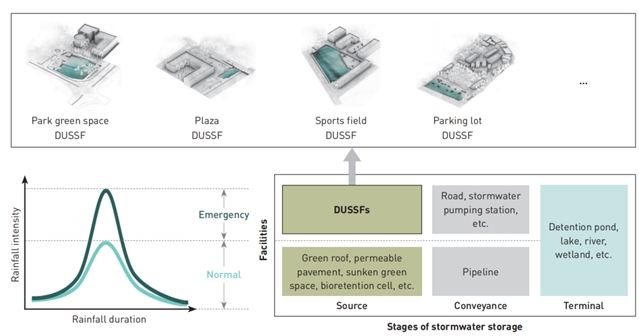
DUSSF在城市雨水调蓄系统中的应用 © 周怀宇
在政策扶持与技术迭代的驱动下,DUSSF在增强城市韧性、盘活存量公共空间、完善排水防涝体系及提升防灾应急能力等方面的价值日益凸显。本研究旨在为城市内涝治理与存量空间优化提供理论参考,拓展规划设计学科的研究方向,并为应对极端暴雨的设计实践提供新的视角与思路。
02.研究方法与数据来源
文献检索与筛选
为确保综述的全面性,本研究首先将“雨水调蓄设施”(stormwater storage facilities)和“平急两用”(dual-use)确定为中心检索词,并将其与概念相近的延伸词一并纳入检索。选取Web of Science(WoS)核心数据库和中国知网(CNKI)作为数据源分别筛选英文、中文文献,于2024年8月进行检索,时间范围不作限定。
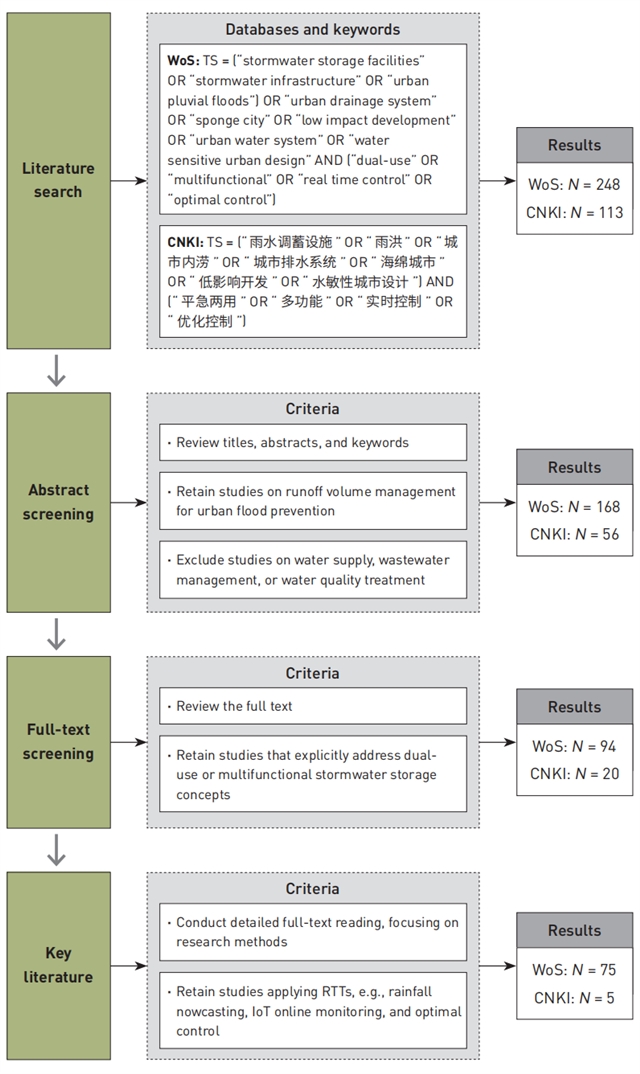
文献筛选方法 © 周怀宇,曲瑶
通过阅读文章标题、摘要和关键词,概览及精读全文,遴选出应用临近降雨预报、物联网在线监测、优化控制等实时技术的重点文献作为研究案例。
文献计量与可视化分析
研究采用逐年变化图呈现DUSSF相关中、英文文献发表数量的变化趋势,并利用CiteSpace 6.4.1对DUSSF学术动态进行可视化分析。首先,利用关键词聚类分析展示DUSSF相关研究的时间跨度、聚类热点演变及聚类热点间关系;随后,利用关键词的突现时间和突现强度来总结DUSSF相关研究的发展阶段。
03.结果与讨论
文献计量与可视化分析结果
经全文筛选后,共有114篇文献被纳入文献计量分析。
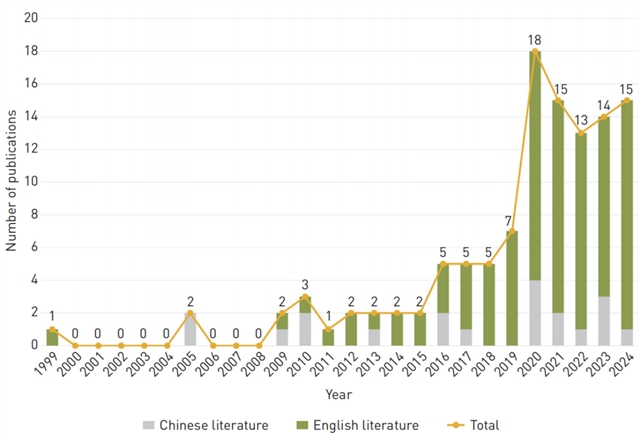
所筛选 DUSSF 相关中英文文献发表数量变化 © 周怀宇,曲瑶
由于中文研究数量不足,研究对94篇英文文献进行了可视化分析。
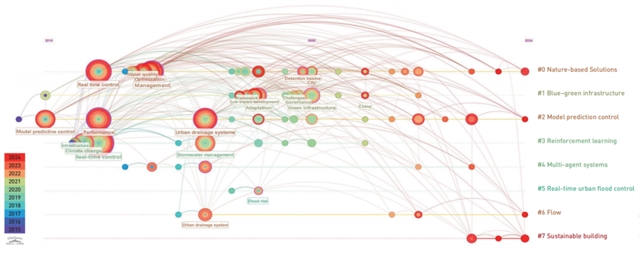
所筛选英文文献聚类时间线分析 © 周怀宇,曲瑶
根据关键词的突现时间与强度分析结果,可将DUSSF的发展划分概念构建阶段(2016-2019)、问题导向阶段(2019-2022)和技术深化阶段(2022-2024)。
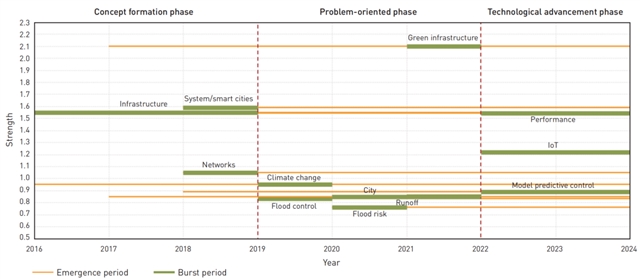
所筛选英文文献关键词突现分析 © 周怀宇,曲瑶
DUSSF研究脉络
DUSSF概念溯源
作为中国公共基础设施政策导向下的新术语,DUSSF虽尚未成为在全球范围内被广泛认可的学术概念,但其背后功能平急转换的核心理念在国内外早期研究与实践中均有迹可循。20世纪末,日本、美国等国家便已开展了DUSSF相关实践。美国低影响开发理念中的多功能SSF强调使用基于景观的解决方案来提高雨水设施的功能实用性。
自2021年中国全域推进海绵城市建设以来,建立兼具雨水调蓄功能的城市开放空间系统逐渐成为了城市设计领域的热点。世界各地也涌现了大量实践案例。
回溯全球DUSSF理论与实践发展,可将DUSSF界定为:综合利用部分城市公共空间,在不影响其平时功能的前提下,经空间改造或同步建设形成的可短时存储雨水的调蓄设施,是海绵城市超标雨水径流处理系统的重要组成部分。
DUSSF分类
目前,学界主要依据管理方式、竖向空间、用地性质对DUSSF进行分类。依据其功能平急转换时是否需人工参与管理决策,可将DUSSF划分为主动管理型和被动转换型。依据设施所处的竖向空间,可将DUSSF分为地上、地下和湖泊3类。依据其所嵌入的城市用地性质,则可划分为公园绿地型、防护绿地型、广场用地型、停车场用地型、体育用地型和市政用地型等类型。不同用地性质对DUSSF的空间设计方案与功能转换逻辑影响显著:公园绿地型DUSSF在平时便发挥一定的基础调蓄功能,应急时则转变为集中调蓄状态;而广场用地型、体育用地型、停车场用地型等硬质空间需通过引流口、临时围挡和排水闸门等构造措施在既有设施体系中“嵌入”应急调蓄功能,日常降雨保持排水畅通,暴雨内涝时按预案启闭形成临时滞蓄区,灾后快速排空并恢复使用。
公园服务效能感知与计算方法
在应对突发性的内涝灾害时,尽管功能平急转换的理念具有突出的优越性,但针对DUSSF“如何启用、怎样恢复”的难题仍缺乏系统性解决方案。
在计量分析中,共筛选出涉及实时技术应用的重点文献80篇(英文75篇,中文5篇)。从全球分布看,美国以27.27%的占比位居第一,其次是中国和澳大利亚,分别为20.45%和9.09%,英国、加拿大、爱沙尼亚等国家和地区也为该领域的发展做出了贡献。表1列举了近年来发表在高水平国际期刊上的单元级与系统级DUSSF管理研究案例,并比较了其场地面积、所采用的实时技术及设施绩效。
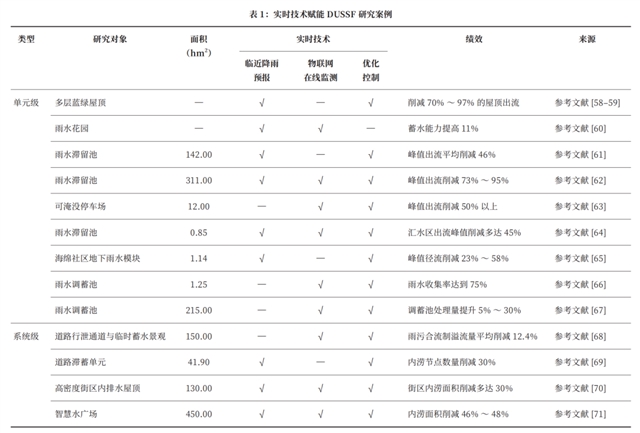
单元级管理
单元级管理指对单体DUSSF运行状态进行优化控制,主要通过在线监测降雨量与积水深度来动态管理设施出流,进而调节暴雨中每个汇水区的峰值出流,缓解下游排水压力。
系统级管理
系统级管理指在相互关联的城市排水区内,通过实时协同管理多个单元级DUSSF,确定优先排水区与错峰排水区,进而减缓高内涝风险区的排水压力。
DUSSF空间优化路径
由综述可知,虽然国内外普遍认为DUSSF在城市排水防涝和应急响应体系中具有较大的应用潜力,但也有学者指出在高密度建成区推广DUSSF仍面临研究与实践瓶颈。
DUSSF的用地识别优化
在城市排水防涝体系中,DUSSF的作用原理与城市蓄滞洪区和雨洪公园类似,注重将城市微观尺度的公共空间转化为临时性调蓄设施。然而,目前对存量公共空间防灾功能的研究主要评估其可达性与供给是否充足,关注这些空间在地震、火灾、公共卫生事件中的安置、疏散、隔离能力,对短时超标雨水径流的应对能力研究相对不足。
DUSSF的全灾害周期配置优化
当前已有研究开始运用遗传算法、模拟退火算法等多目标优化技术平衡各类雨水调蓄设施的水量调控、生态效益与管理成本。城市规划和景观设计学科常用的韧性指标评估法虽已取得较大进展,但仍难以完整反映内涝灾害周期中各项城市功能从失效到恢复的过程,这限制了对不同DUSSF配置方案的比较。
DUSSF的系统级管理优化
引入实时技术显著提升了DUSSF应对突发内涝灾害的能力。目前,基于峰值出流或积水深度的DUSSF单元级管理方法已较为成熟,而聚焦上下游协同的系统级管理研究仍相对较少。
04.结论
总体而论,DUSSF为城市规划和景观设计学科开展城市内涝防治与韧性研究提供了重要契机。首先,在管渠、蓄水池、泵站等传统雨水调蓄系统之外,DUSSF是不可忽视的调蓄空间,因此需建立系统化的DUSSF用地识别方法,明确其空间原型与设计导则,并完善跨部门、跨学科的协同机制,高效衔接存量公共空间与超标雨水径流处理系统。其次,改进多目标优化配置框架,在DUSSF空间配置体系中纳入可反映全灾害周期中城市功能变化的韧性指标,以实现更全面的性能评估。另外,应积极吸纳多学科前沿技术,尤其是基于人工智能的全局风险预测与空间协同技术,探索城市尺度SSF的协同调度方法,从而提升城市系统对内涝灾害的响应速度和管理效能。
参考文献
[1] Agonafir, C., Lakhankar, T., Khanbilvardi, R., Krakauer, N., Radell, D., & Devineni, N. (2023). A review of recent advances in urban flood research. Water Security, 19, 100141.
[2] Cao, W., Zhou, Y., Güneralp, B., Li, X., Zhao, K., & Zhang, H. (2022). Increasing global urban exposure to flooding: An analysis of long-term annual dynamics. Science of The Total Environment, 817, 153012.
[3] Rentschler, J., Avner, P., Marconcini, M., Su, R., Strano, E., Vousdoukas, M., & Hallegatte, S. (2023). Global evidence of rapid urban growth in flood zones since 1985. Nature, 622(7981), 87–92.
[4] Mondal, A., & Garg, R. D. (2025). Global urban flood dynamics and future vulnerability assessment: A comprehensive study of trends, predictions, and mitigation. Natural Hazards, 121(9), 11187–11207.
[5] Ministry of Emergency Management of the People’s Republic of China. (2024). Office of the National Commission for Disaster Reduction and the Ministry of Emergency Management release the national natural disaster situation in the first three quarters of 2024.
[6] Ministry of Emergency Management of the People’s Republic of China. (2024). Office of the National Commission for Disaster Reduction and the Ministry of Emergency Management release the national natural disaster situation in May 2024.
[7] Ministry of Emergency Management of the People’s Republic of China. (2024). Office of the National Commission for Disaster Reduction and the Ministry of Emergency Management release the national natural disaster situation in July 2024.
[8] Yang, L., Li, X., Wang, Y., Wang, B., Zhu, J., Jing, X., & Ning, Q. (2025). Research progress on optimization design and operation dispatch of rainwater storage facilities in sponge cities. Water Resources Protection, 41(1), 140–149.
[9] Yang, D., Cao, Y., & Cao, L. (2019). Technical method and approach for structure of urban ecological stormwater management system. Chinese Landscape Architecture, 35(10), 24–28.
[10] Yang, Y., Shen, M., He, J., Zhu, J., & Cao, P. (2019). Study on the optimization of the decomposition method for total runoff volume capture of annual rainfall in sponge city. Chinese Landscape Architecture, 35(6), 89–93.
[11] Jia, S. (2017). China should prioritize waterlogging prevention for recent urban storm water management. Water Resources Protection, 33(2), 13–15.
[12] Che, W., Zhao, Y., & Li, J. (2015). Considerations and discussions about sponge city. South Architecture, (4), 104–108.
[13] Wang, M., Liu, M., Zhang, D., Qi, J., Fu, W., Zhang, Y., … & Tan, S. K. (2023). Assessing and optimizing the hydrological performance of grey-green infrastructure systems in response to climate change and non-stationary time series. Water Research, 232, 119720.
[14] Guo, L., & Zhai, G. (2024). Reflections on the construction of “dual-use for normal and emergency” facilities in megacities and super-large cities from the perspective of territorial spatial planning. City and Disaster Reduction, (3), 1–5.
[15] Wang, W., Zhu, J., Guo, X., & Ma, D. (2024). Research on the construction of public infrastructure system and its mechanisms for “dual use”. Urban Development Studies, 31(6), 54–61.
[16] Shanghai Water Authority. (2023). Guidelines for the planning and design of dual-use stormwater storage facilities in Shanghai.
[17] Gao, G., Li, M., Wang, Y., Li, Y., & Pan, Z. (2025). Countermeasures to the construction of public infrastructure for “dual use of regular and emergency” in China’s super large cities. Urban Development Studies, 32(1), 1–5.
[18] Zhang, X., Li, J., Li, X., Liu, D., Li, T., Chen, D., & Bu, Y. (2024). Review for urban drainage and waterlogging prevention system with dual use of normal and emergency situations at home and abroad. Water & Wastewater Engineering, 50(10), 43–51.
[19] The State Council of the People’s Republic of China. (2021). Implementation opinions of the General Office of the State Council on strengthening urban waterlogging management.
[20] Ministry of Housing and Urban–Rural Development of the People’s Republic of China. Special planning and design standards for sponge city construction (Draft for Comments).
[21] Lin, H., Wu, X., Pan, J., & Zou, H. (2022). Real-time forecast of urban flood in China: Past, present and future. Acta Geodaetica et Cartographica Sinica, 51(7), 1306–1316.
[22] Ravuri, S., Lenc, K., Willson, M., Kangin, D., Lam, R., Mirowski, P., … & Mohamed, S. (2021). Skilful precipitation nowcasting using deep generative models of radar. Nature, 597(7878), 672–677.
[23] Yuan, J. M., Tilford, K. A., Jiang, H. Y., & Cluckie, I. D. (1999). Real-time urban drainage system modelling using weather radar rainfall data. Physics and Chemistry of the Earth, Part B: Hydrology, Oceans and Atmosphere, 24(8), 915–919.
[24] Zhou, H., Jiang, H., & Liu, H. (2019). Process visualization and performance evaluation of stormwater management in landscape projects based on IoT online monitoring. Chinese Landscape Architecture, 35(10), 29–34.
[25] Zhou, H., & Liu, H. (2021). IoT-based operational information management for built landscape projects: From vacancy to approaches. Landscape Architecture Frontiers, 9(2), 83–95.
[26] Chen, T., Wang, M., Su, J., Ikram, R. M. A., & Li, J. (2023). Application of Internet of Things (IoT) technologies in Green Stormwater Infrastructure (GSI): A bibliometric review. Sustainability, 15(18), 13317.
[27] Xu, W. D., Burns, M. J., Cherqui, F., & Fletcher, T. D. (2021). Enhancing stormwater control measures using real-time control technology: A review. Urban Water Journal, 18(2), 101–114.
[28] Sweetapple, C., Webber, J., Hastings, A., & Melville-Shreeve, P. (2023). Realising smarter stormwater management: A review of the barriers and a roadmap for real world application. Water Research, 244, 120505.
[29] Webber, J. L., Fletcher, T., Farmani, R., Butler, D., & Melville-Shreeve, P. (2022). Moving to a future of smart stormwater management: A review and framework for terminology, research, and future perspectives. Water Research, 218, 118409.
[30] Xie, M., Dong, Z., & Cheng, Y. (2023). A comprehensive study of research frameworks, key technologies and practice cases for sponge city planning based on digital landscape architecture: From hydrological analysis to intelligent monitoring and control. Chinese Landscape Architecture, 39(5), 48–54.
[31] Löwe, R., Vezzaro, L., Mikkelsen, P. S., Grum, M., & Madsen, H. (2016). Probabilistic runoff volume forecasting in risk-based optimization for RTC of urban drainage systems. Environmental Modelling and Software, 80, 143–158.
[32] Lund, N. S. V., Falk, A. K. V., Borup, M., Madsen, H., & Mikkelsen, P. S. (2018). Model predictive control of urban drainage systems: A review and perspective towards smart real-time water management. Critical Reviews in Environmental Science and Technology, 48(3), 279–339.
[33] Técher, D. (2023). Real-time control technology for enhancing biofiltration performances and ecosystem functioning of decentralized bioretention cells. Water Science & Technology, 87(6), 1582–1586.
[34] Kerkez, B., Gruden, C., Lewis, M., Montestruque, L., Quigley, M., Wong, B., … & Pak, C. (2016). Smarter stormwater systems. Environmental Science & Technology, 50(14), 7267–7273.
[35] Brasil, J., Macedo, M., Lago, C., Oliveira, T., Júnior, M., Oliveira, T., & Mendiondo, E. (2021). Nature-based Solutions and real-time control: Challenges and opportunities. Water, 13(5), 651.
[36] Ministry of Land, Infrastructure, Transport and Tourism, Japan. (2024). Draft guidelines for developing comprehensive stormwater management plans: Cases of enhancing urban flood control functions through the utilization of existing stock.
[37] Lloyd, S. D., Wong, T. H. F., & Chesterfield, C. J. (2002). Water sensitive urban design—A stormwater management perspective.
[38] Department of Environmental Resources, Prince George’s County, Maryland, USA. (1999). Low-impact development hydrologic analysis.
[39] Coffman, L. S., Goo, R., & Frederick, R. (1999). Low-impact development: An innovative alternative approach to stormwater management (pp. 1–10). American Society of Civil Engineers.
[40] Jackson, N. (2010, December 1). 2010 America’s Crown Communities Excellence Awards: Downers Grove III, Washington Park stormwater improvement project.
[41] Che, W., Zhang, Y., Li, J., Liu, H., He, J., Meng, G., & Wang, H. (2005). Multi-functional storage of rainwater in urban area. Water & Wastewater Engineering, 31(9), 25–29.
[42] Che, W., Zhang, Y., Liu, H., He, J., Meng, G., & Wang, H. (2005). The multiple-functions flood-proof and adjustment facilities defense against flood disasters. Construction Science and Technology, 22, 20–21.
[43] Li, J., Yu, P., Che, W., & Qiu, S. (2005). Optimization of the scale of urban rainwater accumulation and utilization project. China Water & Wastewater, 21(3), 49–52.
[44] Wang, L., & Zhou, Z. (2018). Sponge wisdom in Holland: Benthemplein Water Plaza, Rotterdam. Chinese & Overseas Architecture, 12, 17–20.
[45] Zhao, H., & Li, Y. (2017). A typical case of flexible stormwater management through multifunctional spatial use: Rotterdam Water Plaza. Urban Planning International, 32(4), 145–150.
[46] Lindholm, O., Svein, E., Sveinn, T., Sveinung, S., Guttorm, J., & Lars, A. (2008). Guidelines for climate-adapted stormwater management [Veiledning i klimatilpasset overvannshåndtering]. Norsk Vann Rapport, 162, 79.
[47] Wei, G., Wang, Y., & Sun, M. (2020). Compound utilization of urban underground space under the background of sponge city. Building Energy Efficiency, 48(4), 126–130.
[48] Wang, Q., Li, H., & Zang, X. (2022). A study on the resilience rating of urban built environment in response to heavy rainfall flooding: Tianjin central city as an example. Architectural Journal, (S2), 201–207.
[49] Wang, Q., Li, H., & Zang, X. (2022). A theoretical framework for resilience of urban built environment in response to rainstorm and waterlogging. Architectural Journal, (S1), 18–23.
[50] Isah, N. (2016). Flood occurrence, smart tunnel operating system and traffic flow: A case of Kuala Lumpur smart tunnel malaysia [Master’s thesis]. Universiti Tun Hussein Onn Malaysia.
[51] Zhu, Y., & Zhang, R. (2022). A preliminary study on the case study and construction method of foreign multi-functional storage parks. Shanxi Architecture, 48(13), 186–188.
[52] Rouault, P., Doering, J., Baier, A., & Meinzinger, F. (2023, July). Multifunctional areas, one of the solutions for Hamburg (Germany) on the way towards a water sensitive city. Novatech 2023.
[53] Shenyang Municipal Urban-Rural Development Bureau. (2023, September 18). Shenyang advances sponge city construction across the entire city: Allowing the city to breathe freely.
[54] Gong, X. (2024). Research on essentials of planning and design for urban rainwater storage facilities with dual use of usual and emergency situations. Urban Roads Bridges & Flood Control, (2), 96–100.
[55] Tang, H., & Li, T. (2009). Present situation and development trend of real time control of urban drainage system. China Water & Wastewater, 25(24), 11–14.
[56] China Urban Water Association. (2023, November 8). Standard for real time control technology of urban drainage system (Draft for comment).
[57] Sales-Ortells, H., & Medema, G. (2015). Microbial health risks associated with exposure to stormwater in a water plaza. Water Research, 74, 34–46.
[58] Busker, T., De Moel, H., Haer, T., Schmeits, M., Van Den Hurk, B., Myers, K., … & Aerts, J. (2022). Blue-green roofs with forecast-based operation to reduce the impact of weather extremes. Journal of Environmental Management, 301, 113750.
[59] Cristiano, E., Lai, F., Deidda, R., & Viola, F. (2023). Management strategies for maximizing the ecohydrological benefits of multilayer blue-green roofs in mediterranean urban areas. Journal of Environmental Management, 343, 118248.
[60] Persaud, P. P., Hathaway, J. M., Kerkez, B., & McCarthy, D. T. (2024). Real-Time Control and Bioretention: Implications for Hydrology. Journal of Sustainable Water in the Built Environment, 10(1), 04023011.
[61] Bilodeau, K., Pelletier, G., & Duchesne, S. (2018). Real-time control of stormwater detention basins as an adaptation measure in mid-size cities. Urban Water Journal, 15(9), 858–867.
[62] Shishegar, S., Duchesne, S., & Pelletier, G. (2019). An integrated optimization and rule-based approach for predictive real time control of urban stormwater management systems. Journal of Hydrology, 577, 124000.
[63] Kändler, N., Annus, I., Vassiljev, A., & Puust, R. (2020). Peak flow reduction from small catchments using smart inlets. Urban Water Journal, 17(7), 577–586.
[64] Zhou, H., Li, R., Liu, H., & Ni, G. (2023). Real-time control enhanced blue-green infrastructure towards torrential events: A smart predictive solution. Urban Climate, 49, 101439.
[65] Sun, L., Xia, J., She, D., Guo, Q., Su, Y., & Wang, W. (2023). Integrated intra-storm predictive analysis and real-time control for urban stormwater storage to reduce flooding risk in cities. Sustainable Cities and Society, 92, 104506.
[66] Xie, M., Wang, R., Yang, J., & Cheng, Y. (2021). A Monitoring and Control System for Stormwater Management of Urban Green Infrastructure. Water, 13(11), 1438.
[67] Zhong, Y., Zi, T., & Zhen, X. (2021). Modeling research on performance improvement of stormwater treatment detention basins by implementing real-time control systems. Water & Wastewater Engineering, 47(4), 144–150.
[68] Lund, N. S. V., Borup, M., Madsen, H., Mark, O., Arnbjerg-Nielsen, K., & Mikkelsen, P. S. (2019). Integrated stormwater inflow control for sewers and green structures in urban landscapes. Nature Sustainability, 2(11), 1003–1010.
[69] Kändler, N., Annus, I., & Vassiljev, A. (2022). Controlling peak runoff from plots by coupling street storage with distributed real time control. Urban Water Journal, 19(1), 97–108.
[70] Zhou, H., Qu, Y., Liu, H., & Ni, G. (2024). Smart roofs featuring predictive control: An upgrade for mitigating precipitation extreme-induced pluvial floods. Journal of Environmental Management, 365, 121504.
[71] Zhou, H., Zhao, X., & Wu, R. (2024). Alleviating urban pluvial floods via dual-use water plazas orchestrated by predictive algorithms. Journal of Hydrology, 640, 131695.
[72] Shishegar, S., Duchesne, S., Pelletier, G., & Ghorbani, R. (2021). A smart predictive framework for system-level stormwater management optimization. Journal of Environmental Management, 278, 111505.
[73] Xin, R., Zeng, J., Li, K., Wang, Q., & Ding, S. (2022). Identify key areas and priority levels of urban waterlogging regulation service supply and demand. Acta Ecologica Sinica, 42(2), 500–512.
[74] Lund, N. S. V., Borup, M., Madsen, H., Mark, O., & Mikkelsen, P. S. (2020). CSO reduction by integrated model predictive control of stormwater inflows: A simulated proof of concept using linear surrogate models. Water Resources Research, 56(8), e2019WR026272.
[75] Liu, H., Zhou, H., & Song, Y. (2024). Wenyu River: Resilience planning study for Beijing’s green belt zone to mitigate flood risks in the Capital. Beijing Planning Review, (1), 46–51.
[76] Fei, W., & Gao, X. (2020). A review on disaster prevention and reduction function of urban green space in China. Journal of Nanjing Forestry University (Natural Sciences Edition), 44(4), 222–230.
[77] Yang, W., Yang, R., & Qiu, Y. (2022). An indicator system for assessment on disaster resilience of urban park green space in South China. Chinese Landscape Architecture, 38(8), 105–110.
[78] Xu, Z., Ye, C., & Liao, R. (2023). Integrated management technology for urban flooding/waterlogging disaster: Research progress and case study. Advances in Earth Science, 38(11), 1107–1120.
[79] Skrede, T. I., Muthanna, T. M., & Alfredesen, K. (2020). Applicability of urban streets as temporary open floodways. Hydrology Research, 51(4), 621–634.
[80] Wang, D., Wang, R., Xin, H., & Li, C. (2024). Design of unconventional road drainage channels based on the principle of combining emergency and normal use. Water & Wastewater Engineering, 50(10), 73–80.
[81] Li, P., Gong, X., & Tan, Q. (2024). Exploration on planning method of dual-purpose facilities for coping with extreme rainstorm in Shanghai central area. Water & Wastewater Engineering, 50(10), 58–64.
[82] Zhu, Y., Xu, C., Liu, Z., Yin, D., Jia, H., & Guan, Y. (2023). Spatial layout optimization of green infrastructure based on life-cycle multi-objective optimization algorithm and SWMM model. Resources, Conservation and Recycling, 191, 106906.
[83] Yao, Y., Li, J., lv, P., Li, N., & Jiang, C. (2022). Optimizing the layout of coupled grey-green stormwater infrastructure with multi-objective oriented decision making. Journal of Cleaner Production, 367, 133061.
[84] Li, J., Li, Y., & Hu, Z. (2022). Multi-objective optimization modeling and application of grey-green coupling stormwater system. Water Resources Protection, 38(6), 49–55.
[85] Song, Q., Zhang, B., Ma, D., & Wang, W. (2024). Review of quantitative assessment methods for community rainstorm resilience. Journal of Catastrophology, 39(2), 212–219.
[86] Zhai, G. (2024). Living with risk: Building the future of resilient cities. Landscape Architecture Frontiers, 12(1), 88–95.
[87] Liu, Y., Wang, Q., Xu, X., Li, M., & Wu, R. (2023). An assessment for the urban waterlogging resilience related to flooding cycle. Water Resources Protection.
[88] Zhai, G. (2024). Resilient planning responses to urban flood disasters in the context of climate change: Key concepts, fundamental ideas, and a comprehensive framework. Urban Planning Forum, (1), 29–37.
[89] Bruneau, M., Chang, S. E., Eguchi, R. T., Lee, G. C., O’Rourke, T. D., Reinhorn, A. M., … & von Winterfeldt, D. (2003). A framework to quantitatively assess and enhance the seismic resilience of communities. Earthquake Spectra, 19(4), 733–752.
[90] Mugume, S. N., Gomez, D. E., Fu, G., Farmani, R., & Butler, D. (2015). A global analysis approach for investigating structural resilience in urban drainage systems. Water Research, 81, 15–26.
[91] Wang, Y., Meng, F., Liu, H., Zhang, C., & Fu, G. (2019). Assessing catchment scale flood resilience of urban areas using a grid cell based metric. Water Research, 163, 114852.
[92] Li, J., & Burian, S. J. (2023). Evaluating real-time control of stormwater drainage network and green stormwater infrastructure for enhancing flooding resilience under future rainfall projections. Resources, Conservation and Recycling, 198, 107123.
[93] Eini, M., Kaboli, H. S., Rashidian, M., & Hedayat, H. (2020). Hazard and vulnerability in urban flood risk mapping: Machine learning techniques and considering the role of urban districts. International Journal of Disaster Risk Reduction, 50, 101687.
[94] Zhou, Q., Teng, S., Situ, Z., Liao, X., Feng, J., Chen, G., … & Lu, Z. (2023). A deep-learning-technique-based data-driven model for accurate and rapid flood predictions in temporal and spatial dimensions. Hydrology and Earth System Sciences, 27(9), 1791–1808.
[95] Lin, L., Tang, C., Liang, Q., Wu, Z., Wang, X., & Zhao, S. (2023). Rapid urban flood risk mapping for data-scarce environments using social sensing and region-stable deep neural network. Journal of Hydrology, 617, 128758.
[96] Bowes, B. D., Tavakoli, A., Wang, C., Heydarian, A., Behl, M., Beling, P. A., & Goodall, J. L. (2021). Flood mitigation in coastal urban catchments using real-time stormwater infrastructure control and reinforcement learning. Journal of Hydroinformatics, 23(3), 529–547.
[97] Luo, X., Liu, P., Xia, Q., Cheng, Q., Liu, W., Mai, Y., … & Wang, D. (2023). Machine learning-based surrogate model assisting stochastic model predictive control of urban drainage systems. Journal of Environmental Management, 346, 118974.

《前沿》系列英文学术期刊
由教育部主管、高等教育出版社主办的《前沿》(Frontiers)系列英文学术期刊,于2006年正式创刊,以网络版和印刷版向全球发行。系列期刊包括基础科学、生命科学、工程技术和人文社会科学四个主题,是我国覆盖学科最广泛的英文学术期刊群,其中12种被SCI收录,其他也被A&HCI、Ei、MEDLINE或相应学科国际权威检索系统收录,具有一定的国际学术影响力。系列期刊采用在线优先出版方式,保证文章以最快速度发表。
中国学术前沿期刊网
http://journal.hep.com.cn

特别声明:本文转载仅仅是出于传播信息的需要,并不意味着代表本网站观点或证实其内容的真实性;如其他媒体、网站或个人从本网站转载使用,须保留本网站注明的“来源”,并自负版权等法律责任;作者如果不希望被转载或者联系转载稿费等事宜,请与我们接洽。