
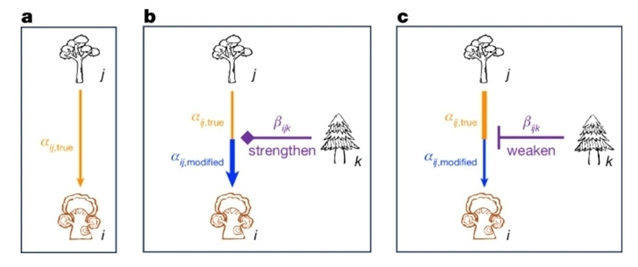
近日,中山大学储诚进团队报道了高阶相互作用增强了树木的纬向多样性梯度。相关论文发表在2026年4月29日出版的《自然》杂志上。
从低纬度到高纬度全球物种多样性的递减,是最为稳健的生物地理格局之一。关于同种负密度依赖对树木纬度多样性梯度的贡献,学界一直存在争议。理论表明,仅基于成对相互作用的同种负密度依赖并不足以解释复杂群落的微妙之处,因为高阶相互作用可能极大地改变这些相互作用。然而,目前仍缺乏实证研究来探讨高阶相互作用如何与成对相互作用交织在一起,以及它们如何影响纬度树木多样性梯度。
研究组分析了32个大型永久森林样地(大多位于北半球)中的成对相互作用和高阶相互作用。在评估树木生长的1543个物种-样地组合中,有40%检测到了高阶相互作用的证据;在评估树木存活的1340个类似组合中,这一比例为23%,且这些相互作用的强度随纬度升高而减弱。研究发现,高阶相互作用有利于稀有物种,而不利于常见物种,这表明了一种促进物种多样性的潜在机制。这种稳定效应随纬度升高而减弱,与纬度树木多样性梯度相一致。该发现揭示了成对相互作用与高阶相互作用在促进纬度树木多样性梯度方面的重要协同作用,并有助于阐明同种负密度依赖对这一生物地理格局的贡献。
附:英文原文
Title: Higher-order interactions enhance the latitudinal tree diversity gradient
Author: Li, Yuanzhi, Xiao, Junli, Jiang, Yuan, Wright, Stuart Joseph, Mayfield, Margaret M., Godoy, Oscar, Alonso, Alfonso, Anderson-Teixeira, Kristina J., Baltzer, Jennifer, Birch, Joseph D., Bissiengou, Pulchrie, Bourg, Norman A., Brockelman, Warren, Burslem, David F. R. P., Cao, Min, Clay, Keith, Davies, Stuart J., Du, Qingqing, Ediriweera, Sisira, Feistner, Anna, Fernando, Edwino S., Gilbert, Gregory S., Hao, Zhanqing, Holk, Jan, Jiang, Mingxi, Jin, Guangze, Johnson, Daniel J., Jones, Alexander S., Krl, Kamil, Larson, Andrew J., Li, Buhang, Lian, Juyu, Lin, Luxiang, Liu, Feng, Liu, Yu, Liu, Zhili, Lutz, James A., Ma, Keping, McMahon, Sean M., McShea, William, Memiaghe, Herv Roland, Mi, Xiangcheng, Myers, Jonathan A., Nasardin, Musalmah, Nathalang, Anuttara, OBrien, Michael J., Obiang, Nestor Laurier Engone, Parker, Geoffrey, Phillips, Richard P., Qiao, Xiujuan, Ren, Haibao, Reynolds, Glen, Rodriguez, Lillian Jennifer V., amonil, Pavel, Shen, Guochun, Shu, Zufei, Shue, Jessica, Swanson, Mark E., Thompson, Jill, Uriarte, Mara, Wang, Xihua, Wang, Xugao, Wang, Youshi, Yao, Tze Leong, Ye, Wanhui, Yu, Mingjian, Zhang, Minhua, Zhu, Yan, Zimmerman, Jess, He, Fangliang, Chu, Chengjin
Issue&Volume: 2026-04-29
Abstract: The global decrease in species diversity from low to high latitudes is among the most robust biogeographic patterns1,2. There is continuing debate on the contribution of conspecific negative density dependence (CNDD) to the latitudinal diversity gradient evident for trees3,4. Theory suggests that CNDD based on pairwise interactions alone is not sufficient to explain the intricacies of diverse communities, because higher-order interactions (HOIs) may greatly modify these interactions5,6. However, there has been a lack of empirical studies investigating how HOIs intertwine with pairwise interactions and how they may contribute to the latitudinal tree diversity gradient. Here we examined both pairwise interactions and HOIs across 32 large permanent forest plots, most in the northern hemisphere. We detected evidence of HOIs in 40% of the 1,543 species–plot combinations for tree growth, and 23% of the 1,340 such combinations for tree survival, with the strength of these interactions declining with latitude. HOIs were found to benefit rare species but disadvantage common species, suggesting a potential mechanism promoting species diversity. This stabilizing effect weakened towards higher latitudes, consistent with the latitudinal tree diversity gradient. Our findings reveal an important interplay between pairwise interactions and HOIs in promoting the latitudinal tree diversity gradient and help to clarify the contribution of CNDD to this biogeographic pattern.
DOI: 10.1038/s41586-026-10434-6
Source: https://www.nature.com/articles/s41586-026-10434-6
Nature:《自然》,创刊于1869年。隶属于施普林格·自然出版集团,最新IF:69.504
官方网址:http://www.nature.com/
投稿链接:http://www.nature.com/authors/submit_manuscript.html