
荷兰伊拉斯谟大学Devika Narain小组近日取得一项新成果。经过不懈努力,他们发现了神经回路编码对时间统计规律的先验知识。相关论文于2026年4月7日发表在《自然—神经科学》杂志上。
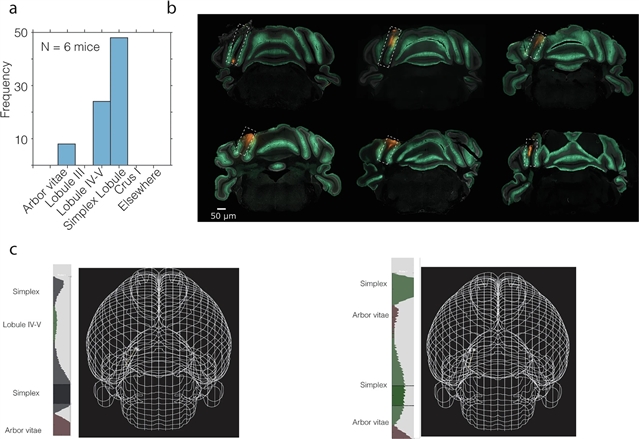
本研究表明,小脑回路在小鼠眨眼条件反射过程中学习时间变量的先验概率分布,并将这些表征编码为浦肯野细胞简单和复杂的尖峰信号。课题组研究人员进一步证明浦肯野细胞参与引发预测性运动行为,如条件眨眼反应,这也反映了实验施加的刺激先验分布的统计数据。这些结果的计算模型表明,小脑浦肯野细胞可以获得由不同概率分布统计形成的先验知识的并置抵消长期可塑性机制。他们的研究结果表明,小脑回路可能是独一无二的,能够学习世界上发生事件的概率,并将其内化为先验知识。这些发现促进了对神经计算如何实现贝叶斯推理的理解。
据介绍,尽管大脑的感官输入和内部过程存在固有的不确定性,但它仍然可以推断外部世界的状态。在高度不确定性的条件下,它越来越依赖于先验知识,这些知识来自于对环境的规律和统计结构积累的经验。这一原则已经被贝叶斯推理理论形式化,它得到了行为和神经科学研究的大量证据的支持。然而,大脑中存在先验知识的直接证据,以及神经回路对环境统计数据的编码,仍然有限。
附:英文原文
Title: Neural circuits encode prior knowledge of temporal statistics
Author: Koppen, Julius, Klinkhamer, Ilse, Runge, Marit, Bayones, Lucas, Narain, Devika
Issue&Volume: 2026-04-07
Abstract: The brain must infer the state of the external world despite the inherent uncertainty of its sensory inputs and internal processes. Under conditions of heightened uncertainty, it increasingly relies on prior knowledge, derived from accumulated experience with the regularities and statistical structures of the environment. This principle has been formalized by Bayesian inference theories, which are supported by substantial evidence from both behavioral and neuroscience studies. However, direct evidence for the existence of prior knowledge in the brain, and for the encoding of environmental statistics by neural circuits, remains limited. Here we show that cerebellar circuits learn the prior probability distribution of temporal variables during eyeblink conditioning in mice and encode these representations in Purkinje cell simple and complex spike signaling. We further demonstrate that Purkinje cells are involved in eliciting predictive motor behaviors, such as the conditioned eyeblink response, that also reflect the statistics of the experimentally imposed prior distribution of the stimulus. Computational modeling of these results indicates the juxtaposition of counteracting long-term plasticity mechanisms by which cerebellar Purkinje cells could acquire prior knowledge that is shaped by the statistics of different probability distributions. Our results suggest that the cerebellar circuitry may be uniquely poised to learn the probability of events in the world and internalize these as prior knowledge. These findings advance understanding of how neural computations could implement Bayesian inference.
DOI: 10.1038/s41593-026-02255-7
Source: https://www.nature.com/articles/s41593-026-02255-7
Nature Neuroscience:《自然—神经科学》,创刊于1998年。隶属于施普林格·自然出版集团,最新IF:28.771
官方网址:https://www.nature.com/neuro/
投稿链接:https://mts-nn.nature.com/cgi-bin/main.plex