
近日,美国麻省理工学院Yihui Quek团队报道了噪声诱发的浅层电路不会出现贫瘠高原。相关论文于2026年4月2日发表在《自然—物理学》杂志上。
如果没有成功实现容错量子纠错,量子计算机上的计算将受到噪声的影响,从而限制其能力。
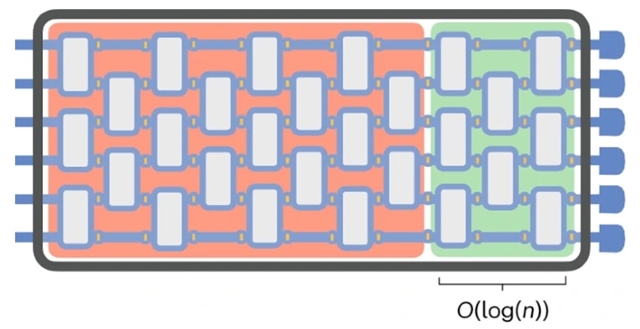
在此,受近期硬件实际考虑的启发,课题组研究了未校正的局域噪声对逻辑量子电路的影响。他们首先证明,在估计可观测期望值的任务中,任何噪声实际上都会将大多数量子电路截断至对数深度。接着,研究组证明,在任意非幺正噪声下,对于由局域可观测量构成的代价函数,量子电路不会出现贫瘠高原。
然而,利用这种有效浅层性,研究组还设计了一种高效的经典算法,能够以高概率(针对电路的选择)在任何电路架构中,在任意常数加法精度内估计可观测期望值。综上所述,该结果表明,除非研究组精心设计量子电路以利用噪声,否则对于输出可观测期望值估计算法(例如许多变分量子机器学习方案),有噪声的量子电路不太可能比浅层电路更具优势。
附:英文原文
Title: Noise-induced shallow circuits and the absence of barren plateaus
Author: Mele, Antonio Anna, Angrisani, Armando, Ghosh, Soumik, Khatri, Sumeet, Eisert, Jens, Stilck Frana, Daniel, Quek, Yihui
Issue&Volume: 2026-04-02
Abstract: Without a successful implementation of fault-tolerant quantum error correction, calculations on quantum computers are subject to noise that limits their capabilities. Here, motivated by realistic near-term hardware considerations, we study the impact of uncorrected local noise on logical quantum circuits. We first show that, in the task of estimating observable expectation values, any noise effectively truncates most quantum circuits to logarithmic depth. We then prove that quantum circuits under any non-unital noise do not exhibit barren plateaus for cost functions composed of local observables. However, by using the effective shallowness, we also design an efficient classical algorithm to estimate observable expectation values within any constant additive accuracy, with high probability over the choice of the circuit, in any circuit architecture. Taken together, our results establish that, unless we carefully engineer quantum circuits to take advantage of the noise, noisy quantum circuits are unlikely to offer an advantage over shallow ones for algorithms that output observable expectation value estimates, such as many variational quantum machine learning proposals.
DOI: 10.1038/s41567-026-03245-z
Source: https://www.nature.com/articles/s41567-026-03245-z