
近日,复旦大学张仁熙团队报道了纳米限域CsPbBr3在硼掺杂介孔TiO2实现内置电场调制的完全选择性CO2-CO光转换。2026年4月16日出版的《德国应用化学》杂志发表了这项成果。
在光催化CO2还原中实现单一产物的选择性仍然是一个巨大挑战。尽管调节催化剂的纳米限域环境可以缓解CO2还原过程中CO和CH4的共生成问题,但纳米限域结构对界面内建电场调控以用于固-气CO2转化的作用受到的关注有限。
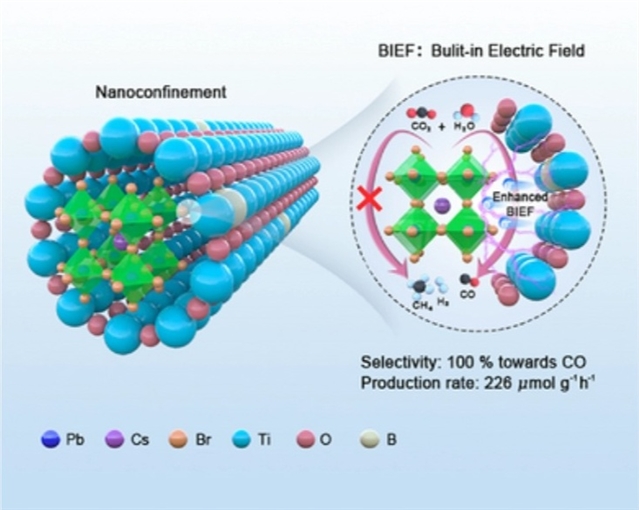
研究组在硼掺杂介孔TiO2的有序孔道内原位生长了CsPbBr3量子点,用于模拟太阳光照射下的CO2光还原反应。所制备的CsPbBr3@BMT复合材料在固-气体系中实现了226 µmol g-1 h-1的CO产率,且选择性基本达到100%(99.9%),在可比条件下优于目前最先进的CsPbBr3基光催化剂。这种新型CsPbBr3@BMT结构实现了量子点在孔道水平的稳定化,纳米笼骨架起到了隔离和稳定量子点的作用,原位XPS和TEM结果证实了这一点。
理论计算表明,硼掺杂与纳米限域的共同作用增强了量子点与BMT之间的界面内建电场,从而改善了电荷分离并抑制了析氢反应。此外,计算还揭示,纳米限域稳定了CO2光还原中的COOH中间体,同时减弱了CO的吸附,使反应体系朝着CO生成与释放的方向进行。这些结果突显了纳米限域作为一种高效、选择性的太阳能驱动CO2-CO转化策略的有效性。
附:英文原文
Title: Nanoconfined CsPbBr3 in Boron-Doped Mesoporous TiO2 Enables Built-In Electric Field Modulation for Fully Selective CO2-to-CO Photoconversion
Author: Yujie Tan, Hui Xu, Nicholas Sammy, Ran Sun, Youxia Liu, Longbo Chang, Kunge Hou, Guocheng Liu, Andrew E. H. Wheatley, Renxi Zhang
Issue&Volume: 2026-04-16
Abstract: Achieving single-product selectivity in photocatalytic CO2 reduction remains an enormous challenge. Although modulating a catalyst's nanoconfined environment can mitigate the co-production of CO and CH4 in CO2 reduction, the contribution of nanoconfined architecture to interfacial built-in electric field (BIEF) regulation for solid-gas CO2 conversion has received limited attention. Herein, CsPbBr3 quantum dots (QDs) are grown in situ within the ordered porosity of boron-doped mesoporous TiO2 (BMT) for CO2 photoreduction under simulated solar irradiation. The composite CsPbBr3@BMT delivers a CO production rate of 226 μmol g1 h1 with essentially 100% (99.9%) selectivity in a solid-gas system, outperforming state-of-the-art CsPbBr3-based photocatalysts under comparable conditions. The new CsPbBr3@BMT architecture integrates pore-level stabilization of QDs, with the nanocage framework isolating and stabilizing the QDs, as evidenced by in situ XPS and TEM. The combination of boron doping and nanoconfinement is shown by theoretical calculations to enhance the BIEF between the QDs and BMT, leading to improved charge separation and suppressed hydrogen evolution. In addition, calculations reveal that nanoconfinement stabilizes the COOH intermediate in CO2 photoreduction while weakening CO adsorption, directing the system toward CO formation and release. These results highlight nanoconfinement as an effective strategy for selective, efficient solar-driven CO2-to-CO conversion.
DOI: 10.1002/anie.4967654
Source: https://onlinelibrary.wiley.com/doi/10.1002/anie.4967654
Angewandte Chemie:《德国应用化学》,创刊于1887年。隶属于德国化学会,最新IF:16.823
官方网址:https://onlinelibrary.wiley.com/journal/15213773
投稿链接:https://www.editorialmanager.com/anie/default.aspx