
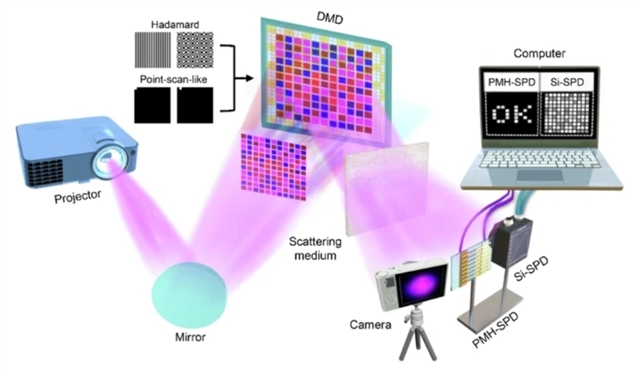
近日,澳门大学刘宏超团队研究了用于彩色图像加密的光可编程双波段钙钛矿单像素探测器。该研究于2026年3月2日发表在《光:科学与应用》杂志上。
窃听技术的快速演进推动着加密系统不断更新与完善。开发一种依赖探测器的光学加密方案,将解密过程与成像过程紧密关联,为防范窃听提供了重要途径。
研究组通过设计一种光学可编程双波段光电探测器,展示了一种彩色图像加密方案——该探测器同时充当探测器和关键解密密钥的角色。光电探测器独特的光学可编程特性使其能够通过短波长光子刺激调控长波长灵敏度,进而导致单像素成像与点扫描成像产生不同的成像结果,最终实现对彩色图像中隐藏信息的解密能力。这种依赖探测器的解密方法能有效防止其他探测器作为窃听设备时可能造成的信息泄露。该加密范式为利用光电探测器实现彩色图像加密开辟了新途径,通过引入基于器件的加密维度提升了加密安全性。
附:英文原文
Title: Optically programmable dual-band perovskite single-pixel detector for color image encryption
Author: Fu, Ai, Zhang, Zhi-Hong, Xiong, Jiahao, Zhang, Xuan, Ye, Zhiyuan, Xiong, Jun, Wei, Zhi-Peng, Zhang, Shuang, Wang, Shuang-Peng, Liu, Hong-Chao
Issue&Volume: 2026-03-02
Abstract: The rapid evolution of eavesdropping technologies has encouraged regular updates and improvement of encryption systems. Developing a detector-dependent optical encryption scheme to tightly connect the decryption and imaging processes offers great potential to prevent eavesdropping. By designing an optically programmable dual-band photodetector, a color image encryption scheme where the photodetector functions as both a detector and a critical decryption key is demonstrated here. The distinctive optically programmable property of the photodetector enables the manipulation of its long-wavelength sensitivity via short-wavelength photonic stimulation, leading to different imaging outputs between single-pixel imaging and point-scan imaging, which therefore demonstrates a capability to decrypt information hidden in color images. This detector-dependent decryption method can effectively prevent potential information leaks when other detectors are used as eavesdropping devices. Our encryption paradigm opens new avenues for color image encryption using photodetectors, enhancing encryption security by introducing a device-based dimension.
DOI: 10.1038/s41377-025-02126-z
Source: https://www.nature.com/articles/s41377-025-02126-z
Light: Science & Applications:《光:科学与应用》,创刊于2012年。隶属于施普林格·自然出版集团,最新IF:19.4
官方网址:https://www.nature.com/lsa/
投稿链接:https://mts-lsa.nature.com/cgi-bin/main.plex