
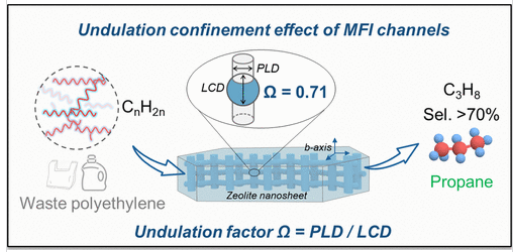
近日,华东师范大学赵晨团队报道了沸石通道波动约束效应促进废聚乙烯选择性升级为丙烷。2026年3月25日,《美国化学会志》发表了这一成果。
将聚乙烯(PE)选择性转化为高价值大宗化学品具有重要的工业应用价值。然而,聚乙烯主链中均匀的碳-碳(C–C)键使其定向裂解成为一项严峻挑战。
研究组开发了一种通道波动限域加氢裂化(CUCH)策略,利用ZSM-5沸石分子筛催化剂,实现了聚乙烯转化中丙烷选择性高达70.2%。这一选择性转化过程源于C–C键的深度β-断裂,以及丙烷分子尺寸与ZSM-5通道波动因子(Ω = 0.71)的匹配性。反应动力学分析、热力学研究及理论计算表明,布朗斯特酸性位点提供质子以活化聚乙烯,引发C–C键断裂,生成烷烃和三配位碳正离子。同时,这些碳正离子的裂解程度受沸石波动因子(Ω)和晶内笼数量(Nc,s)的协同调控。这种双重限域效应延长了C4+中间体的停留时间,最大化其裂解程度,从而提高了丙烷的最终收率。这些发现为废弃聚乙烯的选择性升级回收提供了一种可行的策略。
附:英文原文
Title: Selective Upcycling of Waste Polyethylene into Propane Facilitated by the Undulation Confinement Effect in Zeolite Channels
Author: Yangyang Liu, Bing Ma, Jingqing Tian, Chen Zhao
Issue&Volume: March 25, 2026
Abstract: Selective conversion of polyethylene (PE) into high-value bulk chemicals holds significant industrial application value. However, the uniform C–C bonds in the PE main chain render directed cleavage a formidable challenge. Here we developed a channel undulation-confinement hydrocracking (CUCH) strategy, achieving selectivity of propane up to 70.2% from PE conversion using a ZSM-5 zeolite catalyst. This selective conversion process originates from the deep β-scission of C–C bonds and the match of propane molecular size with the channel undulation factor (Ω = 0.71) of ZSM-5. Reaction kinetics analysis, thermodynamics and theoretical calculation reveal that Brnsted acid sites donate protons to activate PE, initiating C–C bonds cleavage to form alkanes and tricoordinated carbenium ions. Concurrently, the cracking degree of these carbenium ions is modulated by undulation factor (Ω) and the number of intracrystalline cages (Nc,s) in zeolite. This double confinement prolongs the residence time of C4+ intermediates, maximizing their cracking and enhancing the ultimate yield of propane. These findings provide a feasible strategy for the selective upcycling of waste PE.
DOI: 10.1021/jacs.5c21380
Source: https://pubs.acs.org/doi/abs/10.1021/jacs.5c21380
JACS:《美国化学会志》,创刊于1879年。隶属于美国化学会,最新IF:16.383
官方网址:https://pubs.acs.org/journal/jacsat
投稿链接:https://acsparagonplus.acs.org/psweb/loginForm?code=1000