
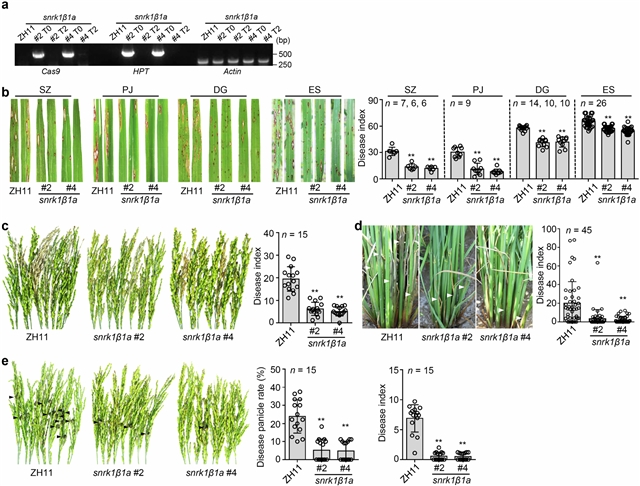
中国农业大学彭友良团队的研究发现灭活SnRK1β1A可促进水稻的广谱抗病性。相关论文于2026年3月25日发表在《自然》杂志上。
在这里,该研究团队报道了SnRK1的β亚基SnRK1β 1a对这些真菌疾病具有广谱敏感性。他们的研究结果表明,多种水稻真菌病原体已经趋同地进化出一种效应物样蛋白Gas2,该蛋白与SnRK1β1A相互作用,阻止其泛素化介导的降解并促进其核易位。SnRK1β 1a显著诱导真菌感染,通过抑制SnRK1α亚基SnRK1α1促进真菌易感性,SnRK1α亚基已知正向调节水稻广谱抗性。
值得注意的是,SnRK1β1A被破坏的水稻品系在正常耕作条件下对几种真菌疾病具有抗性,而不会影响田间生长和产量。这项研究表明,作物的广谱抗病能力可以通过破坏可诱导的易感基因来实现,这些易感基因编码的蛋白质是在几种病原体中保守的效应物的目标。
据了解,水稻是世界上一半以上人口的主要作物,其可持续生产对确保全球粮食安全至关重要。然而,水稻易受几种破坏性真菌疾病的影响,包括稻瘟病(稻瘟病)、枯丝核菌(枯丝核菌)、稻黑穗病(假黑穗病)、稻褐斑病(褐斑病)、黑穗病(黑穗病)和谷瘟病(黑穗病)。对这些真菌疾病易感性的潜在机制尚不清楚。
附:英文原文
Title: Inactivating SnRK1β1A promotes broad-spectrum disease resistance in rice
Author: Yuan, Guixin, Lu, Xunli, Wang, Xingbin, Li, Mengfei, Wang, Shiwei, Huang, Zhaoxiang, Li, Zhigang, Zhang, Fengrui, Zhang, Xin, Yang, Jun, Guo, Hailong, Bhadauria, Vijai, Zhu, Wang-Sheng, Zhao, Wensheng, Yuan, Meng, Zhou, Jian-Min, Peng, You-Liang
Issue&Volume: 2026-03-25
Abstract: Rice is a staple crop for more than half of the world’s population, and its sustainable production is vital to ensure global food security. However, rice is susceptible to several devastating fungal diseases1, including blast disease caused by Magnaporthe oryzae, sheath blight by Rhizoctonia solani, false smut by Ustilaginoidea virens, brown spot by Bipolaris oryzae, bakanae by Fusarium fujikuroi and head blight by Fusarium graminearum. The mechanisms underlying the susceptibility to these fungal diseases remain unclear. Here we report that the β subunit of SnRK1, SnRK1β1A, confers broad-spectrum susceptibility to these fungal diseases. Our findings show that diverse rice fungal pathogens have convergently evolved an effector-like protein, Gas2, which interacts with SnRK1β1A to prevent its ubiquitination-mediated degradation and promotes its nuclear translocation. SnRK1β1A is markedly induced on fungal infection, promoting susceptibility by inhibiting SnRK1α1, an α subunit of SnRK1 known to positively regulate broad-spectrum resistance in rice2. Notably, rice lines with disrupted SnRK1β1A are resistant to several fungal diseases without compromising growth and yield in the field under normal farming conditions. This study demonstrates that broad-spectrum disease resistance in crops can be achieved by disrupting inducible susceptibility genes whose encoded proteins are targeted by effectors conserved across several pathogens.
DOI: 10.1038/s41586-026-10273-5
Source: https://www.nature.com/articles/s41586-026-10273-5
Nature:《自然》,创刊于1869年。隶属于施普林格·自然出版集团,最新IF:69.504
官方网址:http://www.nature.com/
投稿链接:http://www.nature.com/authors/submit_manuscript.html