
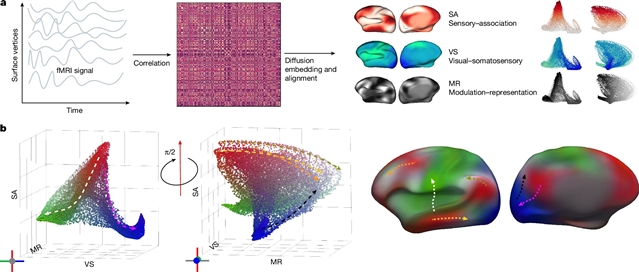
近日,美国北卡罗来纳大学教授Pew-Thian Yap及其小组的研究开发出了人类新皮层在整个生命周期中的功能层次。2026年3月25日出版的《自然》杂志发表了这项成果。
在这里,研究团队建立了一个从出生到100岁的功能组织的连续规范性参考,揭示了复杂的,非线性的发展轨迹。梯度结构在婴儿期以主要感觉系统为基础,在儿童期和青春期沿关联轴和控制轴分化,并在衰老过程中逐渐去分化。这种功能架构的重要性得到了生物学和行为学的证实:梯度度量可以预测整个发展过程中的认知表现;结构-功能耦合随轴和年龄的变化而变化;不同的转录组特征在生命早期最强,随着年龄的增长而减弱,这与梯度结构的瞬时遗传支架一致。它们的寿命梯度统一了发育性大脑连接的不同研究,并为未来的研究提供了共享的多模态参考。
据悉,大脑区域间功能连接的大规模梯度组织了人类新皮层,将大脑地形与认知结构联系起来。在成人中,三个主要轴-感觉-关联、视觉-体感觉和调节-表征分别从初级感觉区到跨模式关联区、从视觉到身体中心系统、从控制和注意网络到默认模式和感觉区。这些梯度提供了大尺度皮层层次结构的简洁描述,这些层次结构是不同信息处理模式的基础。然而,这些梯度及其多尺度生物和认知相关因素如何在整个生命周期中进化尚不清楚。
附:英文原文
Title: Functional hierarchy of the human neocortex across the lifespan
Author: Taylor, Hoyt Patrick, Huynh, Khoi Minh, Thung, Kim-Han, Lin, Guoye, Lyu, Wenjiao, Lin, Weili, Ahmad, Sahar, Yap, Pew-Thian
Issue&Volume: 2026-03-25
Abstract: Large-scale gradients of functional connectivity between brain areas organize the human neocortex, linking brain topography to the texture of cognition1,2. In adults, three dominant axes—sensory–association, visual–somatosensory and modulation–representation—run, respectively, from primary sensory to transmodal association areas, from visual to body-centred systems and from control and attention networks to default mode and sensory areas1,2,3,4. These gradients provide a compact description of large-scale cortical hierarchies that underlie distinct modes of information processing. However, how these gradients and their multiscale biological and cognitive correlates evolve across the lifespan is unknown. Here we establish a continuous normative reference of functional organization from birth to 100 years of age, revealing complex, nonlinear developmental trajectories. Gradient architecture is anchored by primary sensory systems in infancy, differentiates along association and control axes during childhood and adolescence and gradually dedifferentiates during ageing. The importance of this functional architecture is corroborated by biology and behaviour: gradient metrics predict cognitive performance across development; structure–function coupling varies by axis and age; and distinct transcriptomic signatures are strongest early in life and weaken with age, consistent with a transient genetic scaffold for gradient architecture. Our lifespan gradients unify diverse research into developmental brain connectivity and provide a shared multimodal reference for future studies.
DOI: 10.1038/s41586-026-10219-x
Source: https://www.nature.com/articles/s41586-026-10219-x
Nature:《自然》,创刊于1869年。隶属于施普林格·自然出版集团,最新IF:69.504
官方网址:http://www.nature.com/
投稿链接:http://www.nature.com/authors/submit_manuscript.html