
肿瘤中异位的NMDAR表达揭示了种系编码的自身免疫,这一成果由冷泉港实验室Tobias Janowitz小组经过不懈努力而取得。该研究于2026年3月25日发表于国际一流学术期刊《自然》杂志上。
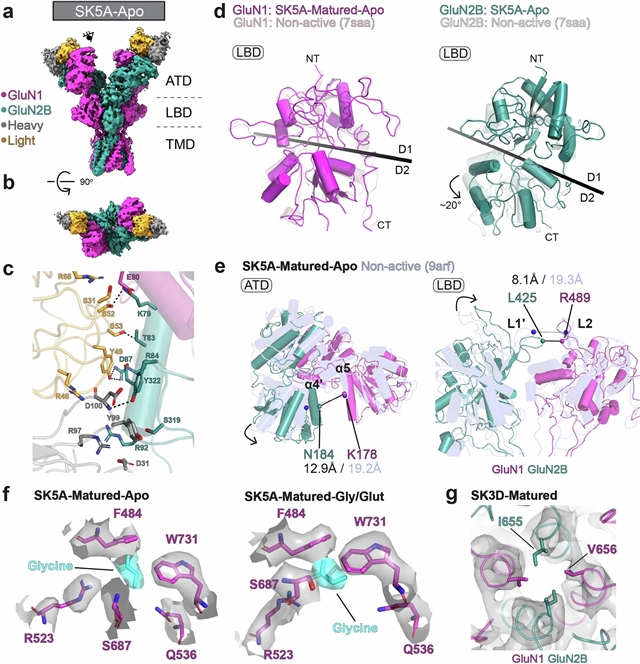
本研究验证了GluN1和GluN2B NMDAR亚基在三阴性乳腺癌(TNBC)6中的异位表达,并通过诱导GluN1 - GluN2B NMDARs的表达来模拟这种主题原位TNBC肿瘤。课题组发现,NMDAR的表达足以诱导B细胞的募集和它们的亲和力成熟,与综合适应性免疫反应一致。扩展瘤内B细胞系统发育的重建和低温电镜结构分析表明,亲和成熟的超突变和类转换抗体来自于先前存在的种系构型低亲和抗NMDAR抗体。
不同的成熟抗体针对特定的表位并诱导NMDAR氨基末端结构域的构象重排,预测其功能作用,从抑制到增强。在健康雌性小鼠中,NMDAR增强抗体的被动转移引导自主神经失调并降低癫痫发作阈值,概括了ANRE4的关键诊断标准。研究团队进一步确定TNBC患者瘤内NMDAR表达与抗NMDAR抗体滴度之间的相关性。综上所述,他们的数据建立了细胞内NMDAR表达、抗体成熟和自身免疫发病之间的直接联系。这些发现表明,种系编码的抗NMDAR抗体有助于免疫监视,但也可能在成熟后引发自身免疫性疾病,揭示了癌症免疫和神经毒性之间的机制权衡。
据介绍,自身免疫和抗癌免疫处于相同的生物学连续体,但它们之间的联系尚不清楚。副肿瘤神经综合征ANRE(抗NMDAR受体(NMDAR)脑炎)是它们连接的一个范例,因为瘤内NMDAR表达与抗NMDAR抗体的产生相关。
附:英文原文
Title: Ectopic NMDAR expression in cancer unmasks germline-encoded autoimmunity
Author: Kleeman, Sam O., Michalski, Kevin, Zhao, Xiang, Steigerwald, Ruben, Ferrer, Miriam, Levett, Llewelyn, Ertel, Ethan, Schultz, Austin, Simorowski, Noriko, Moody, Pamela, Wee, Tse-Luen, Valente, Cristina, Fox, Sharon, Makuch, Mateusz, Thomsen, Selina, Harrison, Ruby, Regan, Claire, Preall, Jonathan, Gao, Qing, Thomas, Dennis, Habel, Jill, Rubino, Rachel, Irani, Sarosh, Furukawa, Hiro, Janowitz, Tobias
Issue&Volume: 2026-03-25
Abstract: Autoimmunity and anti-cancer immunity lie on the same biological continuum1,2, but their link remains obscure. The paraneoplastic neurological syndrome ANRE (anti-NMDA receptor (NMDAR) encephalitis) is a paradigm for their connectivity3, given that intratumoural NMDAR expression is correlated with the generation of anti-NMDAR antibodies4,5. Here we verify ectopic expression of GluN1 and GluN2B NMDAR subunits in triple-negative breast cancer (TNBC)6 and model this using orthotopic TNBC tumours with inducible expression of GluN1–GluN2B NMDARs. We show that NMDAR expression is sufficient to induce the recruitment of B cells and their affinity maturation, consistent with an integrated adaptive immune response. Reconstruction of extended intratumoural B cell phylogenies and cryogenic electron microscopy structural analyses demonstrate that affinity-matured hypermutated and class-switched antibodies emerged from pre-existing germline-configuration lower-affinity anti-NMDAR antibodies. Distinct matured antibodies targeted specific epitopes and induced conformational rearrangements within the NMDAR amino-terminal domain, predictive of their functional effects, ranging from inhibition to potentiation. Passive transfer of an NMDAR-potentiating antibody caused autonomic dysregulation and lowered the seizure threshold in healthy female mice, recapitulating key diagnostic criteria of ANRE4,5. We further identify a correlation between intratumoural NMDAR expression and anti-NMDAR antibody titres in patients with TNBC. Taken together, our data establish a direct connection between intratumoural NMDAR expression, antibody maturation and the onset of autoimmunity. These findings suggest that germline-encoded anti-NMDAR antibodies contribute to immune surveillance but can also trigger autoimmune disease after maturation, revealing a mechanistic trade-off between cancer immunity and neurotoxicity.
DOI: 10.1038/s41586-026-10278-0
Source: https://www.nature.com/articles/s41586-026-10278-0
Nature:《自然》,创刊于1869年。隶属于施普林格·自然出版集团,最新IF:69.504
官方网址:http://www.nature.com/
投稿链接:http://www.nature.com/authors/submit_manuscript.html