
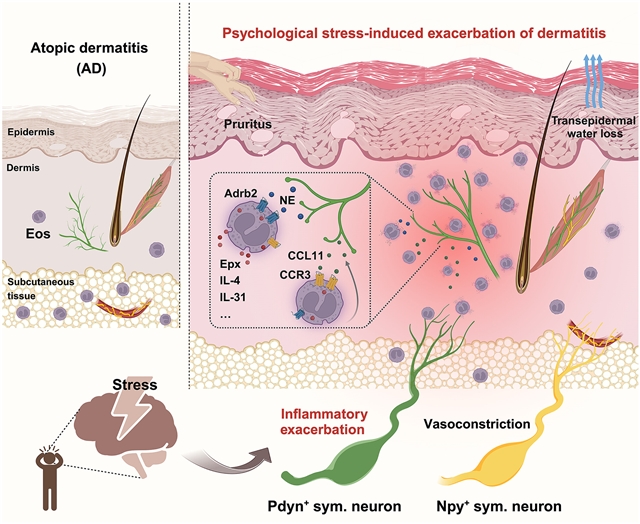
研究小组在小鼠中发现了一个prodynorphin阳性(Pdyn+)去甲肾上腺素能交感神经元亚群,它们特异性地支配毛茸茸的皮肤,以嗜酸性粒细胞依赖的方式介导应激诱导的皮肤炎症加剧。Pdyn+交感神经元或嗜酸性粒细胞的基因消融减轻了特应性皮炎样小鼠应激引起的炎症恶化,而这些神经元的光遗传激活通过嗜酸性粒细胞沉淀炎症。Pdyn+交感神经元通过CCL11-CCR3轴募集嗜酸性粒细胞,并通过炎症皮肤的肾上腺素能受体β2(Adrb2)激活它们。他们的发现揭示了心理应激引起的皮炎恶化的神经免疫学机制,强调Pdyn+交感-嗜酸性粒细胞轴是大脑和皮肤炎症之间的关键界面,具有潜在的治疗意义。
据了解,人们认为心理压力会加剧皮炎,但将压力与免疫过程联系起来的神经生物学机制仍不清楚。
附:英文原文
Title: A sympathetic-eosinophil axis orchestrates psychological stress to exacerbate skin inflammation
Author: Jiahe Tian, Yudian Cao, Yilei Li, Junlong Sun, Cheng Zhan, Wei Ni, Yongjun Zheng, Yanqing Wang, Shenbin Liu
Issue&Volume: 2026-03-19
Abstract: Psychological stress is believed to exacerbate dermatitis, yet the neurobiological mechanisms linking stress to immune processes remain elusive. We identified a subset of prodynorphin-positive (Pdyn+) noradrenergic sympathetic neurons in mice that specifically innervate hairy skin, mediating stress-induced exacerbation of skin inflammation in an eosinophil-dependent manner. Genetic ablation of Pdyn+ sympathetic neurons or eosinophils mitigated stress-evoked worsening of inflammation in atopic dermatitis–like mice, whereas optogenetic activation of these neurons precipitated inflammation through eosinophils. Pdyn+ sympathetic neurons recruited eosinophils through the CCL11-CCR3 axis and activated them through the adrenergic receptor beta2 (Adrb2) in inflamed skin. Our findings reveal a neuroimmunological mechanism underlying psychological stress–induced exacerbation of dermatitis, emphasizing the Pdyn+ sympathetic-eosinophil axis as a crucial interface between the brain and skin inflammation, with potential therapeutic implications.
DOI: adv5974
Source: https://www.science.org/doi/10.1126/science.adv5974