
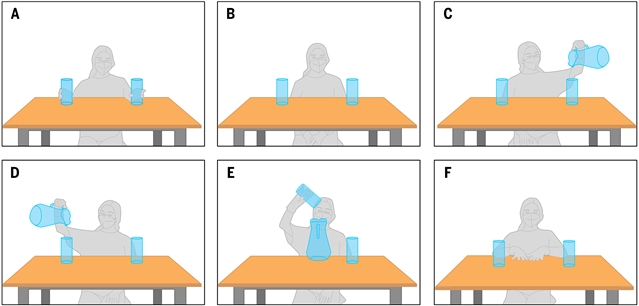
研究小组提出的实验证据表明,非人类灵长类动物可以代表假装的物体。Kanzi是一只接受过词法训练的倭黑猩猩,它能正确地识别出假装物体的位置(例如,在空容器之间放置的“果汁”),这是在架空的假装互动中对口头提示的反应。在三个实验中,该团队从概念上重复了这一发现,并排除了关键的替代解释。他们的研究结果表明,至少在被驯化的猿类的认知潜力范围内,形成对虚拟物体的二次表征的能力可能可以追溯到600万到900万年前,它们共同的进化祖先。
据了解,二次表征使他们的思维脱离此时此地,产生与现实脱钩的想象、假设或替代可能性,支持他们许多最丰富的认知能力,如心理状态归因、对可能未来的模拟和假装。
附:英文原文
Title: Evidence for representation of pretend objects by Kanzi, a language-trained bonobo
Author: Amalia P. M. Bastos, Christopher Krupenye
Issue&Volume: 2026-02-05
Abstract: Secondary representations enable our minds to depart from the here-and-now and generate imaginary, hypothetical, or alternate possibilities that are decoupled from reality, supporting many of our richest cognitive capacities such as mental-state attribution, simulation of possible futures, and pretense. We present experimental evidence that a nonhuman primate can represent pretend objects. Kanzi, a lexigram-trained bonobo, correctly identified the location of pretend objects (e.g., “juice” poured between empty containers), in response to verbal prompts in scaffolded pretense interactions. Across three experiments, we conceptually replicated this finding and excluded key alternative explanations. Our findings suggest that the capacity to form secondary representations of pretend objects is within the cognitive potential of, at least, an enculturated ape and likely dates back 6 to 9 million years, to our common evolutionary ancestors.
DOI: adz0743
Source: https://www.science.org/doi/10.1126/science.adz0743