
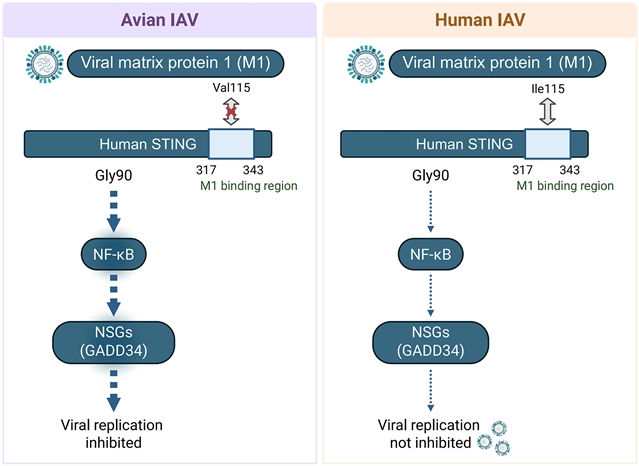
该课题组研究人员证明了人类干扰素刺激基因(STING)是一种针对IAV的传播屏障。STING通过特定的结构域激活核因子κB(NF-κB)和下游NF-κB刺激基因(NSGs)。在这些NSGs中,生长阻滞和DNA损伤诱导蛋白34(GADD34)对IAV的限制至关重要。一些IAV已经进化到通过突变其基质蛋白1(M1)中的残基115来逃避激活人类STING,这对于病毒在人类呼吸细胞中的有效复制至关重要。这种抵抗IAV人畜共患威胁的屏障为进一步研究环鸟苷单磷酸腺苷单磷酸(cGMP-AMP)合成酶(cGAS) -STING-NF -κB信号通路的生物学功能提供了工具。
据介绍,流感大流行通常可追溯到甲型禽流感病毒主题(IAVs)向人类的溢出。然而,防范禽流感传播的障碍仍然存在。
附:英文原文
Title: STING–NF-κB signaling builds an influenza spillover barrier
Author: Runxin Ye, Songdi Wang, Ying Hu, Yiran Pan, Wenwen Zheng, Fengyan Xia, Yanpu Wang, Haoran Guo, Shu Zheng, Wei Wei, Xiao-Fang Yu
Issue&Volume: 2026-02-26
Abstract: Influenza pandemics are often traced back to the spillover of avian influenza A viruses (IAVs) to humans. However, barriers against IAV transmission remain elusive. We demonstrated human stimulator of interferon genes (STING) as a transmission barrier against IAVs. STING activated nuclear factor κB (NF-κB) and downstream NF-κB–stimulated genes (NSGs) through a specific domain. Among these NSGs, growth arrest and DNA damage–inducible protein 34 (GADD34) was crucial for IAV restriction. Some IAVs have evolved to evade activating human STING by mutating residue 115 in their matrix protein 1 (M1), which is essential for efficient viral replication in human respiratory cells. This barrier against the zoonotic threat of IAVs provides a tool for future investigations into the biological functions of the cyclic guanosine monophosphate–adenosine monosphosphate (cGMP-AMP) synthase (cGAS)–STING–NF-κB signaling pathway.
DOI: ads4405
Source: https://www.science.org/doi/10.1126/science.ads4405