
近日,哥伦比亚大学Basov, D. N.团队研究了空腔调控的超导性。这一研究成果发表在2026年2月25日出版的《自然》杂志上。
通过设计材料的电磁环境来改变其基态性质是否可行?受理论预测的启发,无需光学激发即可实现这种腔调控性质的实验研究正逐渐涌现。
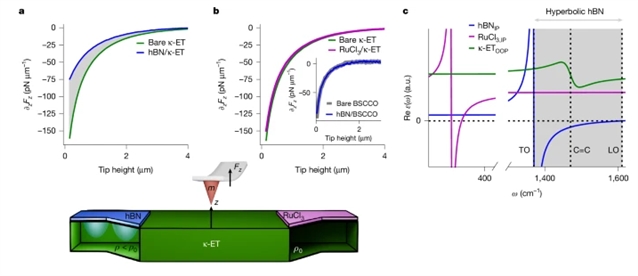
研究组设计并实现了一种全新的平台来获得腔调控材料。双曲型范德瓦尔斯化合物的单晶提供了一个具有增强光子态密度和显著模式限域能力的共振电磁环境。研究组将六方氮化硼与分子超导体κ-(BEDT-TTF)2Cu[N(CN)2]Br(简称κ-ET)结合。hBN的红外双曲模式频率与κ-ET中与超导电性相关的红外活性碳-碳双键(C=C)拉伸分子共振频率相匹配。基于第一性原理分子朗之万动力学模拟的纳米光学数据证实,hBN双曲腔模式与κ-ET中的C=C拉伸模式之间存在共振耦合。
使用磁力显微镜进行的迈斯纳效应测量表明,在hBN/κ-ET界面附近,超流密度被强烈抑制。而非共振的对照异质结构,包括RuCl3/κ-ET和hBN/Bi2Sr2CaCu2O8+x,则未表现出这种显著的超流抑制现象。这些观测结果表明,hBN/κ-ET实现了腔调控的超导基态。该工作凸显了无外部光子的暗腔在调控复杂量子材料电子基态性质方面的潜力。
附:英文原文
Title: Cavity-altered superconductivity
Author: Keren, Itai, Webb, Tatiana A., Zhang, Shuai, Xu, Jikai, Sun, Dihao, Kim, Brian S. Y., Shin, Dongbin, Zhang, Songtian S., Zhang, Junhe, Pereira, Giancarlo, Yao, Juntao, Okugawa, Takuya, Michael, Marios H., Vias Bostrm, Emil, Edgar, James H., Wolf, Stuart, Julian, Matthew, Prasankumar, Rohit P., Miyagawa, Kazuya, Kanoda, Kazushi, Gu, Genda, Cothrine, Matthew, Mandrus, David, Buzzi, Michele, Cavalleri, Andrea, Dean, Cory R., Kennes, Dante M., Millis, Andrew J., Li, Qiang, Sentef, Michael A., Rubio, Angel, Pasupathy, Abhay N., Basov, D. N.
Issue&Volume: 2026-02-25
Abstract: Is it feasible to alter the ground-state properties of a material by engineering its electromagnetic environment Inspired by theoretical predictions1,2,3,4,5,6,7,8,9,10,11,12, experimental realizations of such cavity-controlled properties without optical excitation are beginning to emerge13,14,15,16,17,18,19. Here we devised and implemented a new platform to realize cavity-altered materials. Single crystals of hyperbolic van der Waals (vdW) compounds provide a resonant electromagnetic environment with enhanced density of photonic states and prominent mode confinement20,21,22,23,24. We interfaced hexagonal boron nitride (hBN) with the molecular superconductor κ-(BEDT-TTF)2Cu[N(CN)2]Br (κ-ET). The frequencies of infrared hyperbolic modes (HMs) of hBN (refs.25,26) match the infrared-active carbon–carbon (C=C) stretching molecular resonance of κ-ET implicated in superconductivity27. Nano-optical data supported by first-principles molecular Langevin dynamics simulations confirm the presence of resonant coupling between the hBN hyperbolic cavity modes and the C=C stretching mode in κ-ET. Meissner-effect measurements using magnetic force microscopy (MFM) demonstrate a strong suppression of superfluid density near the hBN/κ-ET interface. Non-resonant control heterostructures, including RuCl3/κ-ET and hBN/Bi2Sr2CaCu2O8+x (BSCCO), do not show the pronounced superfluid suppression. These observations suggest that hBN/κ-ET realizes a cavity-altered superconducting ground state. Our work highlights the potential of dark cavities devoid of external photons for engineering electronic ground-state properties of complex quantum materials.
DOI: 10.1038/s41586-025-10062-6
Source: https://www.nature.com/articles/s41586-025-10062-6
Nature:《自然》,创刊于1869年。隶属于施普林格·自然出版集团,最新IF:69.504
官方网址:http://www.nature.com/
投稿链接:http://www.nature.com/authors/submit_manuscript.html