
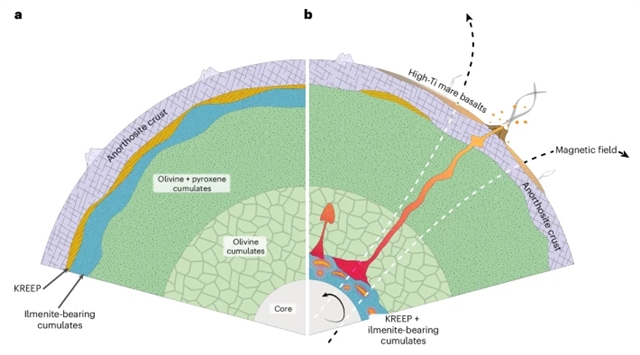
近日,英国牛津大学Claire I. O. Nichols团队报道了间歇性发电机效应与月球上的高钛火山活动有关。相关论文于2026年2月26日发表在《自然—地球科学》杂志上。
月球磁场历史是一个长期存在争议的议题。多项古地磁研究提供了证据表明,在10.2亿至35.8亿年前期间,月球要么持续存在微弱磁场,要么完全缺乏内源磁场。然而针对35.8亿至38.54亿年前这一时期,古地磁研究却在大量微弱或零强度测量值中检测到强内源磁场(>40 µT)的存在。该时期的地壳磁异常也被解读为强、弱磁场同时存在的证据。
研究组通过整合已发表的月球玄武岩古强度、岩石磁学与地球化学数据,发现恢复的古强度值与月球玄武岩钛含量之间存在统计学显著的相关性。通过模拟核幔边界热通量,我们提出月球发电机效应与高钛玄武岩喷发之间存在成因联系——这种联系可能源于含钛铁矿堆晶岩在核幔边界的间歇性熔融。这些稀有事件的时空耦合,很可能反映了高钛玄武岩地体附近的采样偏差。
附:英文原文
Title: An intermittent dynamo linked to high-titanium volcanism on the Moon
Author: Nichols, Claire I. O., Wade, Jon, Stephenson, Simon N.
Issue&Volume: 2026-02-26
Abstract: The history of the lunar magnetic field is a longstanding controversy. Many palaeomagnetic studies provide evidence for either a persistent, weak magnetic field or the lack of an intrinsic magnetic field between 1.020 and 3.580 billion years ago. However, for the period between 3.580 and 3.854 billion years ago, palaeomagnetic studies have recovered strong intrinsic fields (>40μT) distributed among weak or null intensity measurements. Crustal magnetic anomalies from this period have also been interpreted as evidence for the presence of both strong and weak magnetic fields. Here we explore potential links between published palaeointensity, rock magnetic and geochemical data for lunar basalts. We find there is a statistically significant relationship only between recovered palaeointensity and the titanium content of lunar basalts. By modelling the heat flux across the core–mantle boundary, we suggest that there is a causal link between lunar dynamo generation and the eruption of high-titanium basalts. Such a link may result from the intermittent melting of ilmenite-bearing cumulates at the core–mantle boundary. The coincidence of these rare events probably reflects sampling bias near high-titanium basaltic terranes.
DOI: 10.1038/s41561-026-01929-y
Source: https://www.nature.com/articles/s41561-026-01929-y