
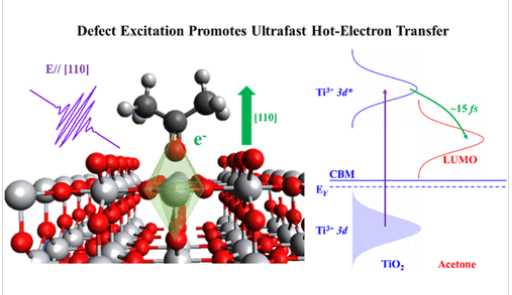
近日,中国科学院大连化物所周传耀团队报道了缺陷的选择性激发促进了半导体界面上的超快热电子转移。这一研究成果发表在2026年2月10日出版的《美国化学会志》上。
缺陷工程是调控光催化材料光吸收与电荷捕获行为、提升太阳能转换效率的有效策略。然而,关于这些缺陷位点向表面吸附物种的光生电荷转移机制——这一连接光吸收与表面化学反应的关键步骤——目前认知尚浅。迄今为止,半导体光催化剂向吸附分子的热电荷转移过程仍未实现直接探测。
研究组结合时间分辨光电子能谱与第一性原理计算,通过丙酮分子吸附于Ti3+缺陷位点时的位点选择性激发(d-d跃迁),首次观测到金红石相TiO2向丙酮的超快热电子转移(~15 fs)。Ti3+离子的高位3d激发态(费米能级以上2.5–2.8 eV)与吸附质轨道的杂化作用,形成了适宜的界面能级排列与强电子耦合,从而促进了热电子转移。这种缺陷介导过程或为吸附物/半导体光捕获体系中的普遍现象。
附:英文原文
Title: Site-Selective Excitation of Defects Promotes Ultrafast Hot-Electron Transfer at the Semiconductor Interface
Author: Tianjun Wang, Kaiping Wang, Huizhi Xie, Wei Chen, Yajie Gao, Shucai Xia, Haochen Wang, Bo Wen, Zefeng Ren, Annabella Selloni, Xueming Yang, Chuanyao Zhou
Issue&Volume: February 10, 2026
Abstract: Defect engineering is an effective strategy to manipulate light absorption and charge trapping in photocatalytic materials and improve their solar energy conversion efficiency. However, little is known about the mechanism of photoinduced charge transfer from these defects to surface-adsorbed species, a key step linking light absorption and surface chemical reactions. Thus far, hot-charge transfer from semiconductor photocatalysts to adsorbed molecules has not yet been directly detected. Combining time-resolved photoelectron spectroscopy and first-principles calculations, we demonstrate the ultrafast hot-electron transfer (~15 fs) from rutile TiO2 to acetone through the site-selective excitation (d-d transition) of Ti3+ defects where acetone is adsorbed. The high-lying 3d excited states of the Ti3+ ions (2.5–2.8 eV above the Fermi level) and their hybridization with adsorbate orbitals provide suitable interfacial level alignment and strong electronic coupling, thus promoting hot-electron transfer. Such a defect-mediated process may be a general phenomenon in adsorbate/semiconductor systems for light harvesting.
DOI: 10.1021/jacs.5c18179
Source: https://pubs.acs.org/doi/abs/10.1021/jacs.5c18179
JACS:《美国化学会志》,创刊于1879年。隶属于美国化学会,最新IF:16.383
官方网址:https://pubs.acs.org/journal/jacsat
投稿链接:https://acsparagonplus.acs.org/psweb/loginForm?code=1000