
中国免疫多组学图谱,这一成果由
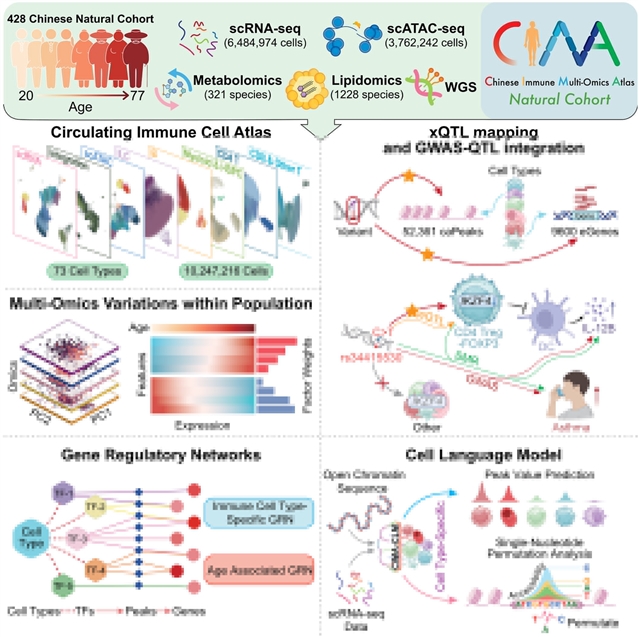
该研究组展示了中国免疫多组学图谱(CIMA),通过对来自428名中国成年人的1000多万个循环免疫细胞的多组学分析,表征了与性别、年龄和遗传变异相关的分子变异。CIMA建立了包含237条基因的增强子驱动基因调控网络;在细胞类型分辨率上鉴定了9600个eGenes和52361个caPeaks;并揭示了免疫相关疾病风险位点、顺式表达数量性状位点(QTLs)和染色质可及性QTLs之间的多效性关联。
此外,细胞语言模型CIMA-CLM预测染色质可及性,并评估来自染色质序列和基因表达的非编码变异的影响。CIMA为免疫相关疾病的研究提供了全面的参考。
据了解,人类外周血在人群中表现出分子和细胞的异质性,但潜在的机制尚不清楚。
附:英文原文
Title: Chinese Immune Multi-Omics Atlas
Issue&Volume: 2026-01-08
Abstract: Human peripheral blood exhibits molecular and cellular heterogeneity across populations, yet the underlying mechanisms remain unclear. We present the Chinese Immune Multi-Omics Atlas (CIMA), characterizing molecular variations linked to sex, age, and genetic variants through multi-omics analysis of more than 10 million circulating immune cells from 428 Chinese adults. CIMA established an enhancer-driven gene regulatory network comprising 237 robust regulons; identified 9600 eGenes and 52,361 caPeaks at cell type resolution; and revealed pleiotropic associations among immune-related disease risk loci, cis-expression quantitative trait loci (QTLs), and chromatin accessibility QTLs. Furthermore, the cell language model CIMA-CLM predicted chromatin accessibility and evaluated the effects of noncoding variants from chromatin sequences and gene expression. CIMA provides a comprehensive reference for immune-related disease research.
DOI: adt3130
Source: https://www.science.org/doi/10.1126/science.adt3130