
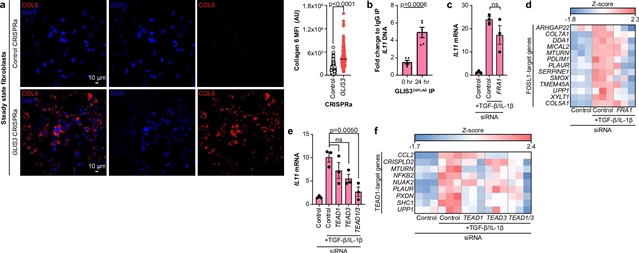
哈佛医学院Ramnik J. Xavier课题组发现了双向CRISPR屏幕解码GLIS3依赖性纤维化细胞回路。相关论文于2026年1月7日发表于国际顶尖学术期刊《自然》杂志上。
通过对炎症性肠病患者肠道组织的综合单细胞和空间分析,研究团队发现了一个以炎症相关成纤维细胞为中心的病理细胞。这些成纤维细胞由促炎巨噬细胞(FCN1+IL1B+)诱导,进而产生促纤维化细胞因子IL-11。小组在机制水平上研究了炎症相关的成纤维细胞激活程序,主题是全基因组CRISPR敲除和激活筛选,并确定转录因子GLIS3是控制炎症和纤维化基因表达的基因调控网络的关键调节因子。研究人员进一步证明,肠道活检中GLIS3基因表达程序的大小可以根据疾病严重程度对溃疡性结肠炎患者进行分层,并且小鼠成纤维细胞特异性缺失Glis3可以减轻慢性结肠炎的病理特征。综上所述,他们的发现确定了一个关键的免疫-基质细胞回路,它在炎症-纤维化循环中起着中心节点的作用。
据介绍,间质细胞室通过协调免疫系统在炎症的开始、扩大和消退过程中,在维持组织稳态中起着核心作用。慢性炎症可阻碍组织修复的阶段性调节,导致纤维化的瘢痕并发症。在炎症性肠病中,间质成纤维细胞参与难治性疾病和纤维化;然而,它们的激活机制仍未明确。
附:英文原文
Title: Bidirectional CRISPR screens decode a GLIS3-dependent fibrotic cell circuit
Author: Pokatayev, Vladislav, Jaiswal, Alok, Shih, Angela R., Segerstolpe, sa, Li, Bihua, Creasey, Elizabeth A., Zhao, Yanhua, Lin, Crystal, Murphy, Shane, Chou, Chih-Hung, Graham, Daniel B., Xavier, Ramnik J.
Issue&Volume: 2026-01-07
Abstract: The stromal cell compartment plays a central part in the maintenance of tissue homeostasis by coordinating with the immune system throughout inception, amplification and resolution of inflammation1. Chronic inflammation can impede the phased regulation of tissue restitution, resulting in the scarring complication of fibrosis. In inflammatory bowel disease, stromal fibroblasts have been implicated in treatment-refractory disease and fibrosis2,3; however, their mechanisms of activation have remained undefined. Through integrative single-cell and spatial profiling of intestinal tissues from patients with inflammatory bowel disease, we uncovered a pathological cell nexus centred on inflammation-associated fibroblasts. These fibroblasts were induced by proinflammatory macrophages (FCN1+IL1B+) and, in turn, produced profibrotic cytokine IL-11. We investigated the inflammation-associated fibroblast activation program at a mechanistic level using genome-wide CRISPR knockout and activation screens and identified the transcription factor GLIS3 as a key regulator of a gene regulatory network governing expression of inflammatory and fibrotic genes. We further demonstrated that the magnitude of the GLIS3 gene expression program in intestinal biopsies could be used to stratify patients with ulcerative colitis by disease severity, and that fibroblast-specific deletion of Glis3 in mice alleviated pathological features of chronic colitis. Taken together, our findings identify a critical immune–stromal cell circuit that functions as a central node in the inflammation–fibrosis cycle.
DOI: 10.1038/s41586-025-09907-x
Source: https://www.nature.com/articles/s41586-025-09907-x
Nature:《自然》,创刊于1869年。隶属于施普林格·自然出版集团,最新IF:69.504
官方网址:http://www.nature.com/
投稿链接:http://www.nature.com/authors/submit_manuscript.html