
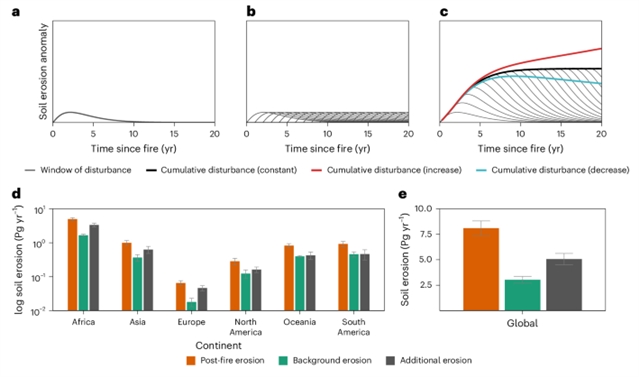
近日,意大利欧洲委员会D. C. S. Vieira团队研究了火灾后土壤侵蚀的全球估算。该研究于2026年1月5日发表在《自然—地球科学》杂志上。
野火影响着全球范围内的地表和火后地貌活动,加剧了地表径流和土壤侵蚀。然而,目前仍缺乏一项综合考虑多次野火累积影响的全球定量评估。
研究组基于过去二十年间野火发生和火势严重程度的全球数据库,以及修订通用土壤流失方程(RUSLE)模型,并结合遥感数据对受烧毁地表的恢复情况,对火后土壤侵蚀进行了全球评估。他们利用全球野火发生和火势严重程度数据库以及修订通用土壤流失方程(RUSLE)模型,结合遥感数据对受烧毁地表的恢复情况,对火后土壤侵蚀的全球趋势进行了估算。
研究结果表明,在考虑多次野火事件的情况下,全球火后土壤侵蚀量每年为8.1±0.72 Pg(注:Pg为十亿吨),占全球土壤侵蚀总量的19%,与火前条件相比,每年额外增加5.1±0.56 Pg的土壤侵蚀量。此外,火后第一年造成的土壤侵蚀量占总土壤侵蚀量的31%,而剩余部分则可归因于之前的野火事件。从全球来看,非洲大陆受火后土壤侵蚀的影响最为严重,因为其烧毁面积要大得多。该研究结果揭示了全球火后土壤侵蚀的严重程度,从而为受影响地区的火后减缓与恢复管理行动以及土地退化零增长政策提供了支持。
附:英文原文
Title: Global estimation of post-fire soil erosion
Author: Vieira, D. C. S., Borrelli, P., Scarpa, S., Liakos, L., Ballabio, C., Panagos, P.
Issue&Volume: 2026-01-05
Abstract: Wildfires affect land surface and post-fire geomorphological activity worldwide, increasing surface runoff and soil erosion. However, a global quantitative assessment considering the cumulative effect of several wildfires is still missing. Here we present a global assessment of post-fire soil erosion, considering cumulative wildfire-driven geomorphological changes over the last two decades. We estimate global trends of post-fire soil erosion using a global database on wildfire occurrence and fire severity, and the Revised Universal Soil Loss Equation (RUSLE) model together with the recovery of those burned landscapes by remote sensed data. Our results show that when considering multiple wildfire events, global post-fire soil erosion accounts for 8.1±0.72Pg annually, representing 19% of the global soil erosion budget and an additional 5.1±0.56Pg soil erosion annually in comparison to pre-fire conditions. Moreover, soil erosion attributed to the first post-fire year represents 31% of the total soil erosion, whereas the remaining share can be attributed to previous wildfire occurrences. Globally, Africa is the continent that is impacted the most in terms of post-fire soil erosion, given its substantially larger burned area. Our results illustrate the magnitude of post-fire soil erosion globally and therefore support post-fire management actions towards the mitigation and restoration of affected areas and policies towards land-degradation neutrality.
DOI: 10.1038/s41561-025-01876-0
Source: https://www.nature.com/articles/s41561-025-01876-0