
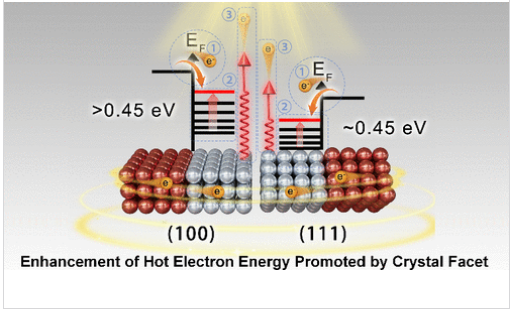
近日,南开大学谢微团队报道了通过调制双金属界面释放等离子体热电子在钯纳米颗粒上的利用以增强光催化。这一研究成果于2025年12月29日发表在《美国化学会志》上。
基于等离激元效应的热电子作为驱动化学转化的非热能源前景广阔,但其催化效能从根本上受限于贵金属本征的费米能级制约。
研究组以钯为例——该材料虽以卓越的催化活性著称,却受限于其较低的费米能级(约-5.1 eV)——通过合理的界面工程策略,成功实现了热电子能量与反应性能的协同提升。通过在钯纳米结构中引入铜,研究组借助定制的Cu-Pd界面电子调制,将热电子能量提升了0.45至75 eV。这一突破开启了以往难以实现的反应路径,最显著的是在Pd(111)表面原位生长铜合成的CuPd Janus纳米颗粒上实现了直接四电子还原过程,而该机制在纯钯体系中并不存在。
此外,Pd(100)晶面的引入进一步协同提升了催化效率,将铃木偶联反应转化率从65%提高至94%,同时反应动力学加速1.6倍。结合原位电化学表面增强拉曼光谱与理论计算,研究组定量证实钯的热电子能级从-5.11 eV上升至-4.66 eV,提升了0.45 eV,从而优化了热电子转移动力学与氧化还原电势。该研究为等离激元光催化剂设计提供了范式转换的新思路,强调通过对热电子能量学与界面电荷转移路径的双重调控,可作为突破能源转换应用中材料本征限制的关键杠杆。
附:英文原文
Title: Unlocking Plasmonic Hot Electron Utilization on Palladium Nanoparticles via Modulation of the Bimetallic Interface for Enhanced Photocatalysis
Author: Yutao Cao, Yonglong Li, Aoxuan Du, Yuying Zhang, Wei Xie
Issue&Volume: December 29, 2025
Abstract: Plasmonically generated hot electrons hold significant promise as nonthermal energy sources for driving chemical transformations, yet their catalytic efficacy is fundamentally constrained by the intrinsic Fermi level (EF) limitations of noble metals. Using palladium (Pd) as a model system─a material renowned for its exceptional catalytic activity but restricted by its low EF (≈ 5.1 eV)─we demonstrate a rational interfacial engineering strategy to amplify hot electron energy and reaction performance. By integrating copper (Cu) into Pd nanostructures, we achieve a 0.45–75 eV elevation in hot electron energy through tailored Cu–Pd interfacial electronic modulation. This advancement unlocks previously inaccessible reaction pathways, most notably enabling a direct four-electron reduction process on CuPd Janus nanoparticles synthesized via in situ Cu growth on Pd(111) surfaces, a mechanism absent in pure Pd systems. Furthermore, the introduction of Pd (100) facets synergistically enhances catalytic efficiency, elevating Suzuki coupling conversion from 65 to 94% while achieving a 1.6-fold acceleration in reaction kinetics. Combining in situ electrochemical surface-enhanced Raman spectroscopy and theoretical calculations, we quantify that the hot electron energy level of Pd increases from 5.11 to 4.66 eV, with an increase of 0.45 eV, thereby optimizing hot electron transfer dynamics and redox potentials. This work provides a paradigm-shifting approach to plasmonic photocatalyst design, emphasizing dual control over hot electron energetics and interfacial charge transfer pathways as critical levers for overcoming inherent material limitations in energy-conversion applications.
DOI: 10.1021/jacs.5c16605
Source: https://pubs.acs.org/doi/abs/10.1021/jacs.5c16605
JACS:《美国化学会志》,创刊于1879年。隶属于美国化学会,最新IF:16.383
官方网址:https://pubs.acs.org/journal/jacsat
投稿链接:https://acsparagonplus.acs.org/psweb/loginForm?code=1000