
近日,北京师范大学丁瑞强团队报道了登陆的热带气旋由于海陆热和粗糙度的对比而加速。这一研究成果于2026年1月27日发表在《自然—地球科学》杂志上。
登陆热带气旋移速的变化对防灾减灾工作构成巨大挑战。近期虽有研究探讨了热带气旋登陆后年平均移速减慢的可能性,但其登陆前的移速变化(特别是小时至日尺度的短期变化)尚未得到系统研究。
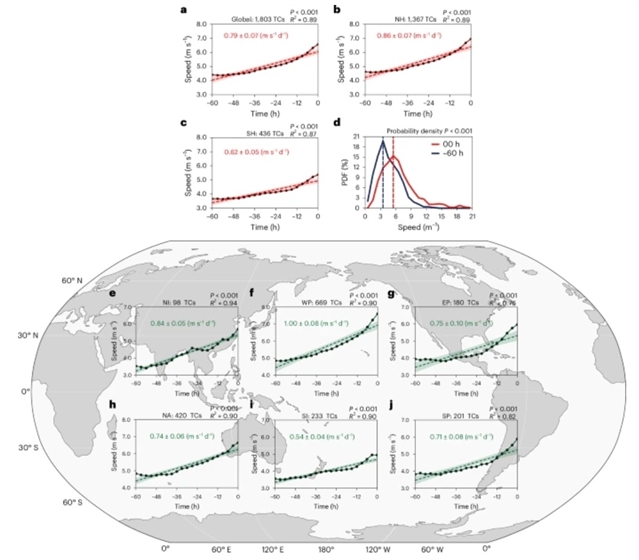
研究组首先基于观测数据发现,全球范围内即将登陆的热带气旋倾向于向海岸加速,平均加速度约为每日0.83米/秒,这意味着登陆热带气旋在登陆前60小时内的平均移速增加约48%。这种加速现象普遍存在于不同强度、不同季节和不同海域的热带气旋中,仅加速幅度存在差异。
数值模拟表明,海陆表面粗糙度差异与热力效应共同导致热带气旋出现不对称环流和对流结构,且随着气旋趋近海岸,这种不对称性进一步增强,引起局地位势涡度变化,从而推动风暴加速。由于这一现象源于海陆差异,任何趋近海岸的热带气旋都可能产生此类加速,因而具有内在必然性。
附:英文原文
Title: Landfalling tropical cyclones accelerate due to land–sea thermal and roughness contrasts
Author: Zhong, Quanjia, Chan, Johnny C. L., Duan, Wansuo, Tu, Shifei, Li, Jianping, Gan, Jianping, Ding, Ruiqiang
Issue&Volume: 2026-01-27
Abstract: Changes in the translation speed of landfalling tropical cyclones (TCs) pose great challenges in disaster preparedness. While some recent studies have discussed the increased chance of a reduction in the annual-mean translation speed of TCs after landfall, such changes before landfall have not been systematically investigated, especially for short-term variations (that is, hour-to-day timescales). Here we show, first based on observations, that globally, a TC about to make landfall tends to accelerate towards the coast, with an average acceleration of about 0.83ms1 per day, which means that the mean translation speed of a landfalling TC increases by ~48% during the 60-h period before landfall. Such an acceleration exists irrespective of TC intensity, seasonality and ocean basin, although its magnitude varies. Numerical simulations demonstrate that land–sea differences in surface roughness and thermal effect result in asymmetric circulation and convection in TCs, both of which are enhanced as the TC moves closer to the coast, leading to local changes in potential vorticity and thereby accelerating the storm. As this phenomenon is due to the land–sea contrast, a TC approaching the coast will probably have such an acceleration and hence it is inherent.
DOI: 10.1038/s41561-025-01891-1
Source: https://www.nature.com/articles/s41561-025-01891-1