
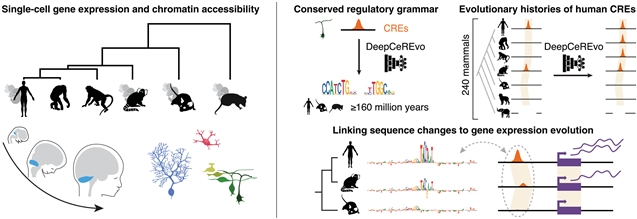
在这项研究中,该团队结合了6种哺乳动物(人类、倭黑猩猩、猕猴、狨猴、小鼠和负鼠)的基因表达和染色质可及性的单核测量,以揭示小脑发育中保守和分化的调控网络。该团队确定了细胞身份的核心调控因子,并开发了基于序列的模型,揭示了保守的调控代码。通过预测240种哺乳动物的染色质可及性,该课题组重建了人类顺式调控元件的进化史,确定了与正选择和基因表达变化相关的集合,包括最近在小脑祖细胞中THRB表达的增加。总的来说,他们的工作揭示了共同的和哺乳动物谱系特异性调节小脑发育的程序。
据介绍,基因调控变化被认为是进化创新的主要驱动力,包括人类进化过程中小脑的扩张,但它们在很大程度上仍未被探索。
附:英文原文
Title: The evolution of gene regulation in mammalian cerebellum development
Author: Ioannis Sarropoulos, Mari Sepp, Tetsuya Yamada, Philipp S. L. Schfer, Nils Trost, Julia Schmidt, Céline Schneider, Charis Drummer, Sophie Mibach, Ibrahim I. Taskiran, Nikolai Hecker, Carmen Bravo González-Blas, Robert Frmel, Piyush Joshi, Evgeny Leushkin, Frederik Arnsktter, Kevin Leiss, Konstantin Okonechnikov, Steven Lisgo, Miklós Palkovits, Svante Pbo, Margarida Cardoso-Moreira, Lena M. Kutscher, Rüdiger Behr, Stefan M. Pfister, Stein Aerts, Henrik Kaessmann
Issue&Volume: 2026-01-29
Abstract: Gene regulatory changes are considered major drivers of evolutionary innovations, including the cerebellum’s expansion during human evolution, yet they remain largely unexplored. In this study, we combined single-nucleus measurements of gene expression and chromatin accessibility from six mammals (human, bonobo, macaque, marmoset, mouse, and opossum) to uncover conserved and diverged regulatory networks in cerebellum development. We identified core regulators of cell identity and developed sequence-based models that revealed conserved regulatory codes. By predicting chromatin accessibility across 240 mammalian species, we reconstructed the evolutionary histories of human cis-regulatory elements, identifying sets associated with positive selection and gene expression changes, including the recent gain of THRB expression in cerebellar progenitor cells. Collectively, our work reveals the shared and mammalian lineage-specific regulatory programs governing cerebellum development.
DOI: adw9154
Source: https://www.science.org/doi/10.1126/science.adw9154