
哈佛医学院Sophie Helaine团队在研究中取得进展。他们开发出一种前噬菌体编码的流产感染蛋白可保全宿主与前噬菌体的传播。相关论文于2026年1月28日发表在《自然》杂志上。
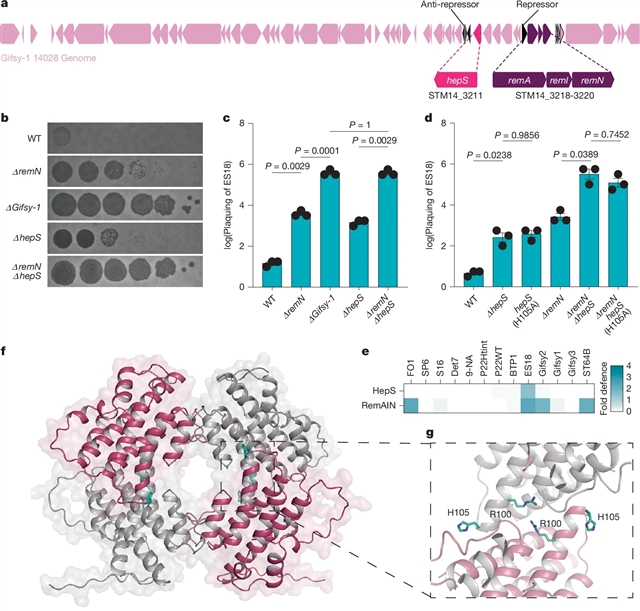
在这里,该课题组鉴定了HepS-一个在Gifsy-1噬菌体上编码的流产感染系统,该系统由一个单一的HEPN结构域蛋白组成,它限制了Siphoviridae家族的噬菌体。该课题组人员证明,在其原生宿主环境的肠炎沙门氏菌血清型鼠伤寒沙门氏菌,HepS既感觉噬菌体感染和实施流产感染。HepS的结构揭示了一种四聚体核酸酶复合体,在产生新的噬菌体颗粒时,该复合体在识别Siphoviridae尾部尖端蛋白时经历变构激活。一旦被激活,HepS就会切割特定的转移RNA反密码子环并阻止噬菌体复制。Gifsy-1是Siphoviridae本身的一种病毒,它通过表达一种不触发HepS的尾尖变体来逃避自我靶向,就像共同居住的Siphoviridae噬菌体Gifsy-2和Gifsy-3一样。这种逃避使得Gifsy-1在编码HepS的情况下仍能传播。这些发现揭示了噬菌体在保持其繁殖能力的同时保护宿主的机制。
据介绍,大多数细菌病原体是多溶原,含有多个垂直传播的前噬菌体。这些噬菌体通过编码毒力因子和抗噬菌体防御系统来增强细菌的致病性和存活率,同时保持水平转移的能力。它们,噬菌体编码的抗噬菌体防御可以阻止外部噬菌体的传播,而不抑制编码它们的噬菌体的传播。
附:英文原文
Title: A prophage-encoded abortive infection protein preserves host and prophage spread
Author: Sargen, Molly R., Antine, Sadie P., Grabe, Grzegorz J., Antonellis, Gabriella, Ragucci, Adelyn E., Li, Yao, Kranzusch, Philip J., Helaine, Sophie
Issue&Volume: 2026-01-28
Abstract: Most bacterial pathogens are polylysogens, harbouring multiple vertically transmitted prophages1,2,3. These prophages enhance bacterial pathogenicity and survival by encoding virulence factors and anti-phage defence systems while retaining the capacity for horizontal transfer. Thus, prophage-encoded anti-phage defences must block propagation of external phages without inhibiting the spread of the prophages that encode them. Here we identify HepS—an abortive infection system encoded on the Gifsy-1 prophage constituted of a single HEPN domain protein—which restricts phages of the Siphoviridae family. We demonstrate that in its native host context of Salmonella enterica serovar Typhimurium, HepS both senses phage infection and enacts abortive infection. Structures of HepS reveal a tetrameric nuclease complex that undergoes allosteric activation upon recognition of Siphoviridae tail tip proteins during production of new phage particles. Once activated, HepS cleaves specific transfer RNA anticodon loops and arrests phage replication. Gifsy-1, a Siphoviridae itself, evades self-targeting by expressing a tail tip variant that does not trigger HepS, as do co-resident Siphoviridae prophages Gifsy-2 and Gifsy-3. This evasion permits Gifsy-1 to spread despite encoding HepS. These findings reveal a mechanism by which a prophage defends the host while maintaining its propagation abilities.
DOI: 10.1038/s41586-025-10070-6
Source: https://www.nature.com/articles/s41586-025-10070-6
Nature:《自然》,创刊于1869年。隶属于施普林格·自然出版集团,最新IF:69.504
官方网址:http://www.nature.com/
投稿链接:http://www.nature.com/authors/submit_manuscript.html