
近日,美国约翰斯·霍普金斯大学Benjamin Fernando团队报道了利用地震数据跟踪空间碎片的再入和解体动力学。相关论文于2026年1月22日发表在《科学》杂志上。
随着地球轨道日益拥挤,再入空间碎片带来的风险持续增加。目前,对不受控再入事件的应对,因无法可靠地追踪航天器进入大气层后的燃烧过程而受到阻碍,这意味着碎片坠落位置的预测准确性很低。
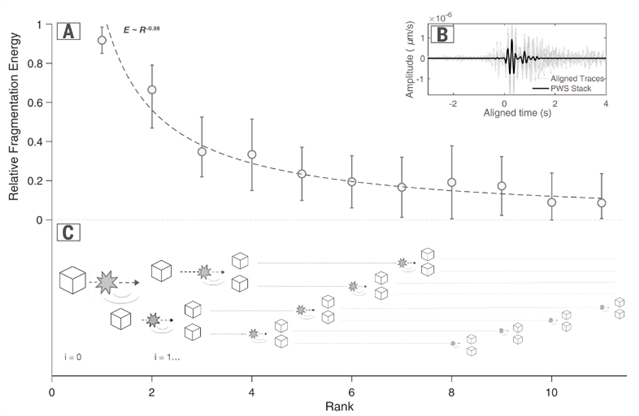
研究组展示了一种最小梯度拟合地震反演方法,该方法能够相对快速地识别出大气层内碎片的轨迹、速度、高度、下降角、尺寸及破碎模式。研究组在2024年神舟十五号再入的开源数据上测试了此方法,得出了一个明显位于预测轨道以南的位置。对级联多重破碎的观测为了解碎片解体动力学提供了洞见,这对空间态势感知和碎片危害减缓具有明确意义。
附:英文原文
Title: Reentry and disintegration dynamics of space debris tracked using seismic data
Author: Benjamin Fernando, Constantinos Charalambous
Issue&Volume: 2026-01-22
Abstract: The risks posed by reentering space debris continue to grow as Earth’s orbit becomes more crowded. Currently, responses to uncontrolled reentries are hampered by an inability to reliably track spacecraft once they are burning up within the atmosphere, meaning that debris fallout locations are poorly predicted. We have demonstrated a minimum-gradient fit seismic inversion methodology that allows in-atmosphere debris trajectory, speed, altitude, descent angle, size, and fragmentation pattern to be discerned relatively quickly. We tested this methodology on open-source data from the 2024 reentry of Shenzhou-15, deriving a location significantly south of the predicted track. Observations of cascading, multiplicative fragmentation offer insight into debris disintegration dynamics, with clear implications for space situational awareness and debris hazard mitigation.
DOI: adz4676
Source: https://www.science.org/doi/10.1126/science.adz4676