
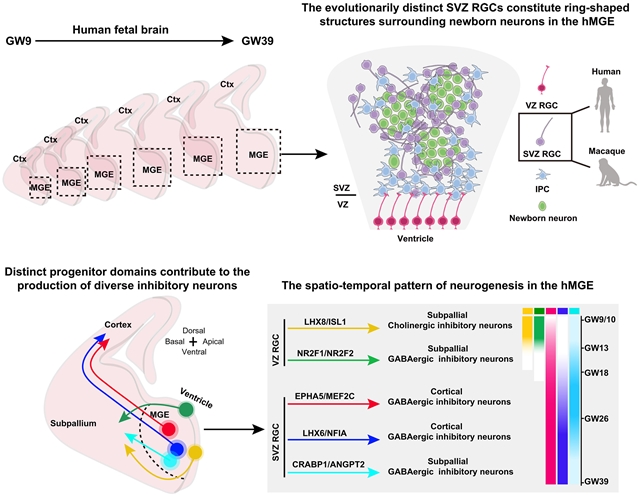
小组对人类内侧神经节隆起(hMGE)进行了空间和单细胞转录组学研究,并建立了hMGE来源的细胞在大脑发育过程中的轨迹。小组确定了时空和分子分离的祖细胞群体,注定要产生不同的IN类型。研究人员在脑室下区发现了一种进化上独特的祖细胞类型,在人类大脑发育的整个过程中,这种祖细胞维持了脑内蛋白和神经胶质细胞的产生。他们的发现揭示了IN生成的进化特征,并揭示了人类大脑发育的独特机制。
据介绍,在哺乳动物脑进化过程中,抑制性神经元(INs)的数量和多样性显著增加。然而,大量人类基因的生成机制仍然是未知的。
附:英文原文
Title: Subventricular zone radial glial cells maintain inhibitory neuron production in the human brain
Author: Longzhong Jia, Xiaohan Li, Yiming Yan, Linhe Xu, Jianbin Guo, Weichao Wang, Weirong Zhang, Lianyan Li, Borui Shang, Yiwei Zhang, Yashan Dang, Yuyan Zeng, Zhiyan Liao, Ruijuan Liang, Li Gu, Chenyi He, Zhen Long, Hanqing Hou, Yuhan Zhou, Mingchao Yan, Wei Huang, Lan Zhu, Da Mi
Issue&Volume: 2026-01-15
Abstract: The number and diversity of inhibitory neurons (INs) increased substantially during mammalian brain evolution. However, the generative mechanisms of the vast repertoire of human INs remain elusive. We performed spatial and single-cell transcriptomics of human medial ganglionic eminence (hMGE), a pivotal source of cortical and subpallial INs, and built the trajectories of hMGE-derived cells during brain development. We identified spatiotemporally and molecularly segregated progenitor cell populations fated to produce distinct IN types. We uncovered an evolutionarily distinct progenitor cell type in the hMGE subventricular zone that maintained the production of INs and glial cells throughout human brain development. Our findings reveal evolutionarily distinct features of IN generation and shed light on the distinct mechanisms underlying human brain development.
DOI: adw1803
Source: https://www.science.org/doi/10.1126/science.adw1803