
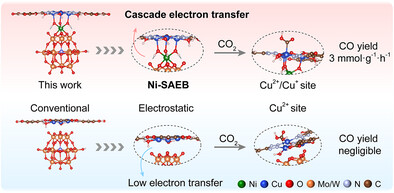
近日,黑龙江大学李玉鑫团队揭示了单原子电子桥促进级联电子从封装的多金属氧酸盐转移到金属有机框架,用于有效的光催化CO2转化。该研究于2026年1月14日发表在《德国应用化学》杂志上。
整合多金属氧酸盐与金属有机框架优异特性的POM@MOF复合体系展现出显著的催化潜力。然而,两种组分间缺乏稳定且明确的电子转移通道,阻碍了电荷分离与传输,从而限制了其催化效率。
研究组基于先前报道的PMo11W@rht-MOF-1复合材料,在POM与MOF之间构建了镍单原子电子桥结构。球差校正透射电镜与X射线吸收谱分析不仅揭示了单原子镍、POM及MOF的多级分散状态,更证实了镍原子与POM和MOF间均形成化学键合。飞秒瞬态吸收光谱与原位X射线光电子能谱研究表明,这种精确设计的镍单原子电子桥成功促进了从包覆的PMo11W到rht-MOF-1骨架的级联电子转移。
进一步研究发现,该镍单原子电子桥/POM@MOF体系可同时利用POM的“电子海绵效应”与MOF的CO2吸附-转化能力。因此,镍单原子电子桥修饰的PMo11W@rht-MOF-1复合材料实现了3 mmol g-1 h-1的CO2光催化转化生成CO速率,显著优于未修饰镍单原子电子桥的原始体系。该工作确立了单原子电子桥作为一种普适性催化策略——单原子既可充当表面催化中心,又能作为界面级联电子介导单元,具有广泛的科学意义。
附:英文原文
Title: Single-atom Electronic Bridge Facilitates Cascade Electron Transfer From Encapsulated Polyoxometalate to Metal-Organic Framework for Efficient Photocatalytic CO2 Conversion
Author: Shengqian Yu, Zicheng Wang, Yihong Xie, Guangming Li, Yuxin Li
Issue&Volume: 2026-01-14
Abstract: The POM@MOF system, integrating the exceptional properties of polyoxometalates (POM) and metal-organic frameworks (MOF), exhibits considerable catalytic potential. However, the absence of stable and well-defined electron-transfer pathways between the two components hampers charge separation and transport, thereby limiting its catalytic efficiency. Here, we constructed a Ni single-atom electronic bridge (SAEB) between POM and MOF, based on our previously-reported PMo11W@rht-MOF-1 composite. Spherical aberration-corrected transmission electron microscopy and X-ray absorption spectroscopy analyses revealed not only the hierarchical dispersion of single-atom Ni, POM, and MOF, but also the formation of chemical bonds between Ni and both POM and MOF. This precisely engineered Ni-SAEB facilitated cascade electron transfer from the encapsulated PMo11W to rht-MOF-1 framework, as confirmed by femtosecond transient absorption spectroscopy and in situ X-ray photoelectron spectroscopy. Further investigations demonstrated that the Ni-SAEB/POM@MOF system simultaneously harnessed the “electronic sponge” effect of POM and the CO2 adsorption-conversion capability of MOF. Consequently, the Ni-SAEB/PMo11W@rht-MOF-1 composite achieved a CO2-to-CO photocatalytic conversion rate of 3 mmol g1 h1, markedly surpassing that of PMo11W@rht-MOF-1 without Ni-SAEB. This work establishes the SAEB strategy as a versatile catalytic concept, where single atoms serve as both surface catalytic centers and interfacial cascade electron mediators, with broad scientific significance.
DOI: 10.1002/anie.202524558
Source: https://onlinelibrary.wiley.com/doi/10.1002/anie.202524558
Angewandte Chemie:《德国应用化学》,创刊于1887年。隶属于德国化学会,最新IF:16.823
官方网址:https://onlinelibrary.wiley.com/journal/15213773
投稿链接:https://www.editorialmanager.com/anie/default.aspx