
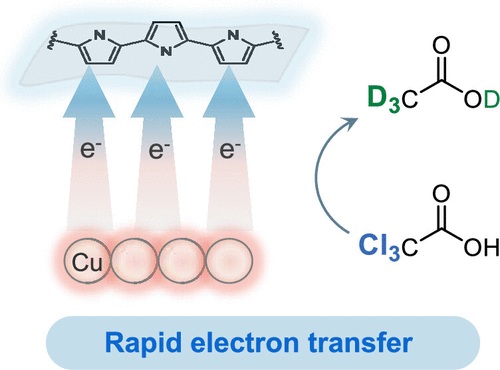
D2O电催化三氯乙酸(TCAA)重氘是合成乙酸-d3酸-d (AA-d4)的一种很有前途的方法,但其效率受到多质子/电子转移动力学缓慢和C-Cl键难以裂解的高过电位的限制。设计了一种内置强电场(BEF)的聚吡咯修饰铜电催化剂(Cu@PPy),可有效降低过电位100 mV,以94%的FE高选择性电合成AA-d4,优于纯Cu。Cu/PPy界面处的强BEF有利于K·D2O向电极表面迁移,促进界面D2O重定向为D-down构型,从而促进D2O的解离,为后续的TCAA氘化提供*D。
此外,电场增强的吸附和加速的电子转移促进了C-Cl键的激活,从而改善了脱氯和氘动力学。该策略可以在2.5 A下放大AA-d4的电合成,具有85%的高FE,在2.25 V的较低电池电压下工作,突出了其潜力。
附:英文原文
Title: Constructing a Built-In Electric Field via Polymer Modification to Boost D2O Reorientation and Electron Transfer for Deuteroacetic Acid Electrosynthesis
Author: Meng He, Jianbo Xu, Haotian Wang, Rui Li, Chuanqi Cheng, Bin Zhang
Issue&Volume: December 3, 2025
Abstract: Electrocatalytic deuteration of trichloroacetic acid (TCAA) with D2O is a promising strategy for the synthesis of acetic-d3 acid-d (AA-d4), but its efficiency is limited by high overpotentials caused by sluggish multiproton/electron transfer kinetics and difficult cleavage of the C–Cl bond. Here, a polypyrrole-modified copper electrocatalyst (Cu@PPy) with a strong built-in electric field (BEF) is designed, effectively reducing the overpotential by 100 mV for the high-selectivity electrosynthesis of AA-d4 with a 94% FE, outperforming pure Cu. The strong BEF at the Cu/PPy interface facilitates the migration of K·D2O to the electrode surface and promotes the reorientation of the interfacial D2O into a D-down configuration, thereby promoting the dissociation of D2O to supply *D for subsequent TCAA deuteration. Moreover, the enhanced adsorption and accelerated electron transfer arising from the electric field promote C–Cl bond activation, thus improving the dechlorination and deuteration kinetics. This strategy enables scale-up electrosynthesis of AA-d4 at 2.5 A with a high FE of 85%, operating at a lower cell voltage of 2.25 V, highlighting its potential.
DOI: 10.1021/jacs.5c17591
Source: https://pubs.acs.org/doi/abs/10.1021/jacs.5c17591
JACS:《美国化学会志》,创刊于1879年。隶属于美国化学会,最新IF:16.383
官方网址:https://pubs.acs.org/journal/jacsat
投稿链接:https://acsparagonplus.acs.org/psweb/loginForm?code=1000