
近日,
联氨氧化反应(HzOR)已成为一种很有前途的替代析氧反应(OER)的高效制氢阳极反应。然而,双电极电解槽需要大量的电池电压和不间断的外部电源,限制了可扩展的实施。
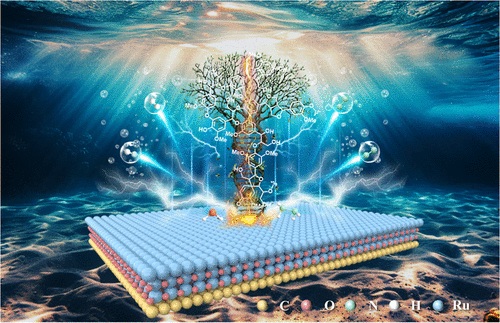
在这里,水热活化木质素与Ru3+螯合,以指导Ru/RuO2异质结的原位形成,在热解后,嵌入在层次化木质素衍生碳(HLC)基质中,生成Ru/RuO2@HLC催化剂。结合光谱和DFT计算揭示了界面处的动态双中心(DDC): Ru4+ -O-Ru0电子桥向RuO2注入电荷,而相邻的Ru发生可逆的部分氧化(Ru0 Ru3+)在偏置下。该DDC略微拉长Ru-O并压缩Ru - Ru,使晶格氧富集,加速了界面电荷转移,降低了* 2nh→*2N这一限速阶的自由能垒至1.31 eV,抑制了高价Ru的溶解。在1.0 M KOH电解质中,制备的Ru/RuO2@HLC催化剂在极低的过电位12 mV下实现了50 mA cm-2的析氢反应(HER)电流密度,超过了商用Pt/C。用HzOR代替OER可显著降低电池电压,在100 mA cm-2时仅为0.14 V。配对的直接联氨燃料电池和集成的整体联氨分裂以大约100%的法拉第效率提供2.32 mmol h-1的氢气,代表了迄今为止自供电联氨系统中最高的产氢率之一。这项工作为废物制氢提供了一个可扩展的平台,并强调了可再生生物质配体在构建高性能界面电催化剂方面的潜力。
附:英文原文
Title: Lignin-Directed Construction of Vertical Ru/RuO2 Electron–Bridge Interfaces for Low-Input Self-Powered Hydrazine-Water Splitting
Author: Jianglin Liu, Jinhui Zhang, Liheng Chen, Yanlin Qin, Xuliang Lin, Xueqing Qiu
Issue&Volume: December 3, 2025
Abstract: Hydrazine oxidation reaction (HzOR) has emerged as a promising anodic alternative to the oxygen evolution reaction (OER) for efficient hydrogen production. Nevertheless, two-electrode electrolyzers demand substantial cell voltages and uninterrupted external power, curbing scalable implementation. Herein, hydrothermally activated lignin chelates with Ru3+ to direct the in situ formation of Ru/RuO2 heterojunctions that, upon pyrolysis, are embedded within a hierarchical lignin-derived carbon (HLC) matrix to yield the Ru/RuO2@HLC catalyst. Combined spectroscopy and DFT calculation uncover a dynamic dual-center (DDC) at the interface: a Ru4+–O–Ru0 electron bridge injects charge into RuO2, while adjacent Ru undergoes reversible partial oxidation (Ru0 Ru3+) under bias. This DDC slightly elongates Ru–O and compresses Ru–Ru, enriches lattice oxygen, accelerates interfacial charge transfer, lowers the free-energy barrier of the rate-limiting *2NH → *2N step to 1.31 eV, and suppresses high-valence Ru dissolution. In 1.0 M KOH electrolyte, the as-prepared Ru/RuO2@HLC catalyst achieves a hydrogen evolution reaction (HER) current density of 50 mA cm–2 at an exceptionally low overpotential of 12 mV and surpasses commercial Pt/C. Replacing OER with HzOR significantly reduces the cell voltage to only 0.14 V at 100 mA cm–2. A paired direct hydrazine fuel cell and an integrated overall hydrazine splitting deliver 2.32 mmol h–1 of hydrogen at approximately 100% Faradaic efficiency, representing one of the highest hydrogen production rates reported to date for self-powered hydrazine systems. This work provides a scalable platform for waste-to-hydrogen conversion and highlights the potential of renewable biomass ligands for constructing high-performance interfacial electrocatalysts.
DOI: 10.1021/jacs.5c15759
Source: https://pubs.acs.org/doi/abs/10.1021/jacs.5c15759
JACS:《美国化学会志》,创刊于1879年。隶属于美国化学会,最新IF:16.383
官方网址:https://pubs.acs.org/journal/jacsat
投稿链接:https://acsparagonplus.acs.org/psweb/loginForm?code=1000