
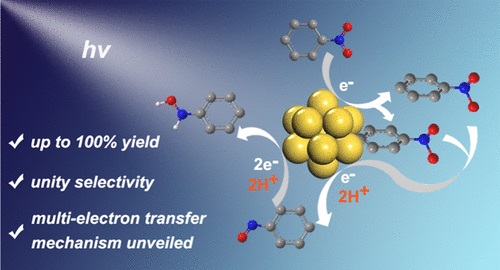
了一种吡啶修饰的N-杂环碳(NHC)稳定的Au13纳米管(Au NC)作为硝基苯(NB)多电子还原的可见光催化剂的主题。在照射3 h后,NB光还原成N-苯羟胺(PHA),具有统一的选择性和产物收率。光催化还原通过电子-质子和电子-电子过程进行。NB首先被Au NC (Au NC*)的激发态还原生成离子对(Au NC+和NB•–)。离子对内Au NC的进一步激发和外部质子的参与导致NB•–转化为亚硝基苯(NSB)。第一步的差分控制电子转移是速率决定步骤,第二步的动态和静态猝灭结合加速了Au NC*向NB•–的电子转移。导致最终产物的第三次和第五次电子转移事件比第一次要快得多。密度泛函理论(DFT)模拟将PHA的选择性形成与其在Au NC上的弱吸附联系起来,这是由Au NC的疏水相互作用和芘配体的电子效应驱动的。Au NC*的激发态还原电位为- 1.69 V vs SCE(饱和甘汞电极),与常见主题的CdS量子点光催化剂相当。这项NB光还原研究为研究NHC稳定金纳米管在高能量多电子转移光催化反应中的复杂机制提供了有价值的见解。
附:英文原文
Title: Harnessing the Potent Excited-State Reductive Power of Pyrene-Modified N-Heterocyclic Carbene-Stabilized Au13 Nanoclusters for Four-Electron Nitroarene Reduction with Unity Selectivity
Author: Pengju Li, Zijian Zhao, Limei Tian, Rong Liu, Xiaotong Wang, Weijian Yang, Yun-Shu Cui, Mark G. Humphrey, Chi Zhang, Ke Hu
Issue&Volume: December 1, 2025
Abstract: This work describes the use of a pyrene-modified N-heterocyclic carbene (NHC)-stabilized Au13 nanocluster (denoted as Au NC) as the visible light photocatalyst in the multielectron reduction of nitrobenzene (NB). The photoreduction of NB to N-phenylhydroxylamine (PHA) proceeds with unity selectivity and product yield after 3 h of irradiation. The photocatalytic reduction proceeds via a four-electron and four-proton process. NB is first reduced by the excited state of the Au NC (Au NC*) to yield the ion pair (Au NC+ and NB–). Further excitation of Au NC within the ion pair and involvement of external protons result in the reduction of NB– to nitrosobenzene (NSB). The diffusion-controlled electron transfer in the first step is the rate-determining step, with the combination of dynamic and static quenching in the second step expediting electron transfer from Au NC* to NB–. The third and fourth electron transfer events that lead to the final product are much faster than the first. Density functional theory (DFT) simulations link the selective formation of PHA to its weak adsorption on Au NC, driven by hydrophobic interactions and electronic effects of the pyrene ligands of Au NC. The excited-state reduction potential of Au NC* is 1.69 V vs SCE (Saturated Calomel Electrode), comparable to those of commonly used CdS quantum dot-based photocatalysts. This NB photoreduction study has afforded valuable insights into the intricate mechanisms at NHC-stabilized gold nanoclusters in energy-demanding multielectron transfer photocatalytic reactions.
DOI: 10.1021/jacs.5c11969
Source: https://pubs.acs.org/doi/abs/10.1021/jacs.5c11969
JACS:《美国化学会志》,创刊于1879年。隶属于美国化学会,最新IF:16.383
官方网址:https://pubs.acs.org/journal/jacsat
投稿链接:https://acsparagonplus.acs.org/psweb/loginForm?code=1000