
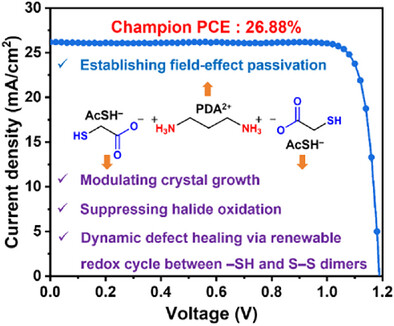
近日,四川大学彭强团队报道了分子整合策略可同时调制高效倒置钙钛矿太阳能电池的晶体生长和界面能量损失。2025年12月17日出版的《德国应用化学》杂志发表了这项成果。
严重的界面能量损失与晶体质量缺陷仍是制约高性能钙钛矿太阳能电池发展的关键瓶颈。
研究组通过分子整合策略设计出一种多功能分子——1,3-丙二胺二巯基乙酸酯(PDA(AcSH)2),可同步解决上述问题。PDA2+阳离子优先富集于钙钛矿/C60界面,通过建立场效应钝化层有效抑制界面接触诱导的非辐射复合。与此同时,AcSH-阴离子均匀分布于整个钙钛矿层,通过─SH与─COO-双功能基团的双重键合作用调控晶体生长并钝化带电缺陷。AcSH-中可还原的─SH基团还能将光热生成的I2/I3-物种转化为I-,形成可逆的S─S二聚体;该二聚体在紫外光照下可光解再生─SH基团,从而构建动态缺陷修复的自持续氧化还原循环,显著提升了前驱体与薄膜的稳定性。
基于此策略优化的小面积器件(0.09 cm2)获得了26.88%的认证效率,非辐射电压损失仅为64 mV。该策略具有良好的可扩展性,1 cm2器件与12.96 cm2微型组件分别实现了24.92%和22.73%的效率。该研究充分展示了理性分子设计在同步抑制体相与界面能量损失方面的有效性,为开发下一代高性能、高稳定性、可规模化制备的钙钛矿太阳能电池开辟了新路径。
附:英文原文
Title: Molecular Integration Strategy Enables Simultaneous Modulation of Crystal Growth and Interfacial Energy Loss for Efficient Inverted Perovskite Solar Cells
Author: Yuqi Yao, Qi Wang, Wei Hui, Lin Song, Xiaopeng Xu, Yihui Wu, Qiang Peng
Issue&Volume: 2025-12-17
Abstract: Severe interfacial energy loss and inferior crystal quality remain key limitations for high-performance perovskite solar cells (PSCs). Herein, we report a multifunctional molecule, 1,3-propanediamine dimercaptoacetate (PDA(AcSH)2), designed through a molecular-integration strategy to address these challenges simultaneously. The PDA2+ cations preferentially accumulate at the perovskite/C60 interface, establishing a field-effect passivation that suppresses interfacial contact induced non-radiative recombination. Meanwhile, the AcSH– anions are homogeneously distributed throughout the perovskite layer, mediating crystal growth and passivating charged traps via dual binding of ─SH and ─COO– groups. The reducible ─SH groups in AcSH– also convert photo-thermally generated I2/I3– species into I–, forming reversible S─S dimers that photodecompose under UV light illumination to regenerate ─SH groups. This enables a self-sustaining redox cycle for dynamic defect healing and enhances both precursor and film stability. Consequently, the optimized small-area (0.09-cm2) device achieves impressive efficiency of 26.88% and a non-radiative voltage loss of only 64 mV. The strategy is readily scalable, delivering efficiencies of 24.92% and 22.73% for 1-cm2 device and 12.96-cm2 mini-module, respectively. This work highlights the effectiveness of rational molecular design in mitigating both bulk and interfacial energy losses, paving the way for the next generation of high-performance, stable, and scalable PSCs.
DOI: 10.1002/anie.202524806
Source: https://onlinelibrary.wiley.com/doi/10.1002/anie.202524806
Angewandte Chemie:《德国应用化学》,创刊于1887年。隶属于德国化学会,最新IF:16.823
官方网址:https://onlinelibrary.wiley.com/journal/15213773
投稿链接:https://www.editorialmanager.com/anie/default.aspx