
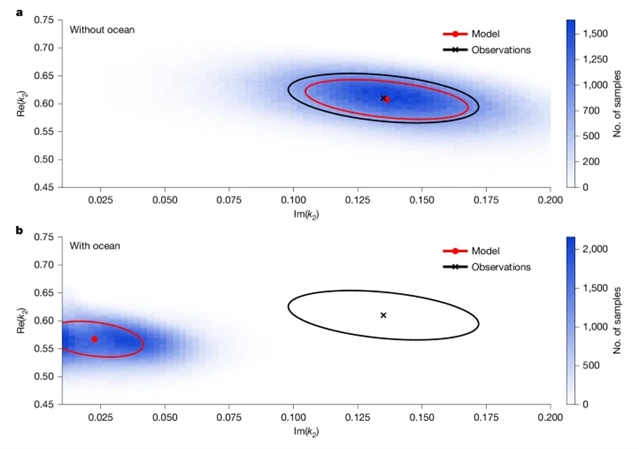
近日,美国加州理工学院Flavio Petricca团队报道了土卫六强烈的潮汐耗散使地下海洋无法存在。相关论文于2025年12月17日发表在《自然》杂志上。
卡西尼号任务为理解土星最大的卫星——土卫六(泰坦)——提供了从大气层到深层内部前所未有的洞察。该卫星对土星潮汐作用的显著响应曾被解释为存在地下海洋的证据。然而,这一响应值是卡西尼号探测前研究预测值的两倍,其完整机制至今未得到充分解释。
研究组通过运用改进技术重新分析卡西尼号获得的无线电测量数据,探测到土卫六重力场中的潮汐耗散特征,发现该特征与存在海洋的假设并不相符。研究结果表明,其内部正在耗散大量能量(约3–4 TW,对应的潮汐品质因子Q ≈ 5),这与近期对土卫六自转状态的研究结果一致。由于液态层的存在会减弱其下方产生的潮汐耗散,这些新测量数据排除了土卫六存在地下海洋的可能性,并可通过一个模型得到合理解释——该模型中耗散集中于接近熔点的冰层高压区域。
此模型还能自洽地复现观测到的土卫六自转状态和静态重力场,使所有现有地球物理测量数据得到统一解释。高效的冰壳对流可以阻止大范围融化和海洋的形成,但高压冰层处于半融雪状符合理论预期,表明该层可能存在液态水囊。即将开展的蜻蜓号土卫六探测任务将为验证是否存在地下海洋提供进一步证据。
附:英文原文
Title: Titan’s strong tidal dissipation precludes a subsurface ocean
Author: Petricca, Flavio, Vance, Steven D., Parisi, Marzia, Buccino, Dustin, Cascioli, Gael, Castillo-Rogez, Julie, Downey, Brynna G., Nimmo, Francis, Tobie, Gabriel, Journaux, Baptiste, Magnanini, Andrea, Jones, Ula, Panning, Mark, Bagheri, Amirhossein, Genova, Antonio, Lunine, Jonathan I.
Issue&Volume: 2025-12-17
Abstract: The Cassini mission provided unprecedented insights into Saturn’s largest moon, Titan, from its atmosphere to the deep interior1. The moon’s large measured response to the tides exerted by Saturn was interpreted as evidence of the existence of a subsurface ocean2,3. This response, twice the value predicted in pre-Cassini studies, has escaped complete explanation. Here we show that the signature of tidal dissipation in Titan’s gravity field is not consistent with the presence of an ocean. Our results arise from the detection of this signature through a reanalysis of the radiometric data acquired by Cassini with improved techniques. We found that substantial energy is being dissipated in the interior (approximately 3–4TW, corresponding to a tidal quality factor Q≈5), consistent with recent studies of Titan’s rotational state4. Because the presence of a liquid layer reduces the tidal dissipation generated below it5, these new measurements preclude the existence of a subsurface ocean on Titan and are explained by a model in which dissipation is concentrated in a high-pressure ice layer close to its melting point. This model also reproduces Titan’s observed rotational state and static gravity field self-consistently, reconciling all available geophysical measurements. Efficient ice shell convection can prevent widespread melting and ocean formation, but a slushy high-pressure ice layer is consistent with expectations6, indicating that it probably hosts liquid water pockets. The forthcoming Dragonfly mission to Titan will provide a further test of whether a subsurface ocean exists.
DOI: 10.1038/s41586-025-09818-x
Source: https://www.nature.com/articles/s41586-025-09818-x
Nature:《自然》,创刊于1869年。隶属于施普林格·自然出版集团,最新IF:69.504
官方网址:http://www.nature.com/
投稿链接:http://www.nature.com/authors/submit_manuscript.html