
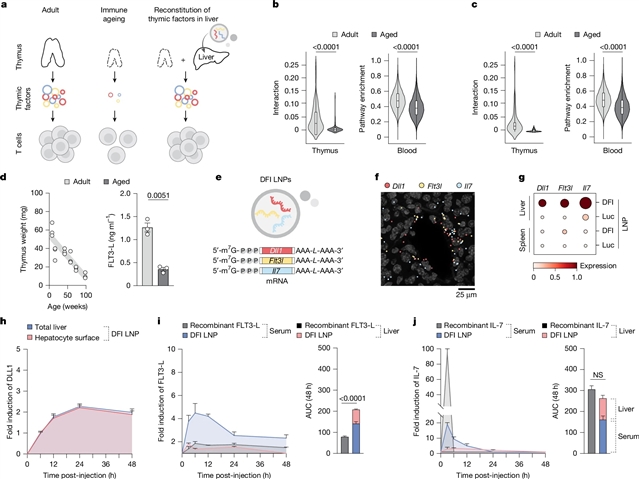
麻省理工学院和哈佛大学的布罗德研究所张锋团队近日取得一项新成果。经过不懈努力,他们的最新研究探明了肝脏营养因子的短暂重建增强老年人免疫力。相关论文于2025年12月17日发表在《自然》杂志上。
在这里,课题组人员表明,肝脏可以短暂地重新利用,以恢复年龄减少的免疫信号,并改善老年小鼠的T细胞功能。这些免疫线索是通过对幼龄和老年动物的中央和外周生态位进行多组学定位发现的,导致Notch和Fms样酪氨酸激酶3配体(FLT3L)途径以及白细胞介素-7 (IL-7)信号通路随着年龄的增长而下降。将编码δ样配体1 (DLL1)、FLT3L和IL-7的mRNAs递送至肝细胞,可扩大普通淋巴样祖细胞,促进新生胸腺生成,而不影响造血干细胞(HSC)组成,并在增强树突状细胞丰度和功能的同时补充T细胞。这些mRNAs通过增加肿瘤特异性CD8+浸润和克隆多样性以及与免疫检查点阻断的协同作用,改善了多肽疫苗应答,恢复了老年小鼠的抗肿瘤免疫。这些作用在停止给药后是可逆的,并且不破坏自身耐受性,这与重组细胞因子治疗的炎症和自身免疫缺陷形成对比。这些发现强调了基于mRNAs的系统性免疫调节策略的前景,并强调了旨在保持老年人免疫恢复力的干预措施的潜力。
据了解,衰老部分通过重塑T细胞库来侵蚀人体免疫力,导致对感染、恶性肿瘤和疫苗失败的脆弱性增加。恢复免疫功能的尝试只产生了适度的结果,并且受到毒性或缺乏临床可行性的限制。
附:英文原文
Title: Transient hepatic reconstitution of trophic factors enhances aged immunity
Author: Friedrich, Mirco J., Pham, Julie, Tian, Jiakun, Chen, Hongyu, Huang, Jiahao, Kehl, Niklas, Liu, Sophia, Lash, Blake, Chen, Fei, Wang, Xiao, Macrae, Rhiannon K., Zhang, Feng
Issue&Volume: 2025-12-17
Abstract: Ageing erodes human immunity, in part by reshaping the T cell repertoire, leading to increased vulnerability to infection, malignancy and vaccine failure1,2,3. Attempts to rejuvenate immune function have yielded only modest results and are limited by toxicity or lack of clinical feasibility1,3,4,5. Here we show that the liver can be transiently repurposed to restore age-diminished immune cues and improve T cell function in aged mice. These immune cues were found by performing multi-omic mapping across central and peripheral niches in young and aged animals, leading to the identification of Notch and Fms-like tyrosine kinase 3 ligand (FLT3L) pathways, together with interleukin-7 (IL-7) signalling, as declining with age. Delivery of mRNAs encoding Delta-like ligand 1 (DLL1), FLT3L and IL-7 to hepatocytes expanded common lymphoid progenitors, boosted de novo thymopoiesis without affecting haematopoietic stem cell (HSC) composition, and replenished T cells while enhancing dendritic cell abundance and function. Treatment with these mRNAs improved peptide vaccine responses and restored antitumour immunity in aged mice by increasing tumour-specific CD8+ infiltration and clonal diversity and synergizing with immune checkpoint blockade. These effects were reversible after dosing ceased and did not breach self-tolerance, in contrast to the inflammatory and autoimmune liabilities of recombinant cytokine treatments6,7. These findings underscore the promise of mRNA-based strategies for systemic immune modulation and highlight the potential of interventions aimed at preserving immune resilience in ageing populations.
DOI: 10.1038/s41586-025-09873-4
Source: https://www.nature.com/articles/s41586-025-09873-4
Nature:《自然》,创刊于1869年。隶属于施普林格·自然出版集团,最新IF:69.504
官方网址:http://www.nature.com/
投稿链接:http://www.nature.com/authors/submit_manuscript.html