
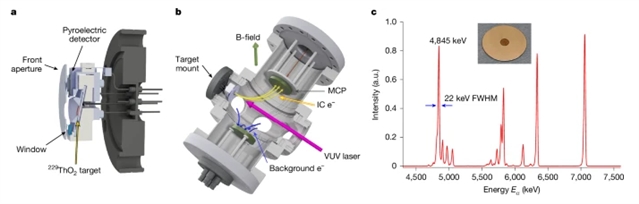
近日,美国加州大学洛杉矶分校Hudson, Eric R.团队研究了基于激光的229ThO2转换电子穆斯堡尔谱。相关论文发表在2025年12月10日出版的《自然》杂志上。
超低能量的钍-229核同质异能态有望推动多项全新且强大的应用,包括构建稳健便携的固态核钟(或有助于重新定义"秒"单位)、探索核超辐射现象及检验基础物理理论。此外,类似传统穆斯堡尔光谱学的功能,该核态对环境的高度敏感性可用于实现激光穆斯堡尔光谱学,进而开发新型应变与温度传感器,并形成对固态环境的新型探测手段,所有这些应用均具备卓越的灵敏度。然而,当前研究固态核跃迁的模型必须使用高带隙、透真空紫外的基质材料,严重限制了这些技术的适用性。
研究组首次在氧化钍薄膜中演示了激光诱导内转换电子穆斯堡尔光谱学对钍-229同质异能态的探测——该材料的带隙(约6电子伏特)显著低于核同质异能态能量(8.4电子伏特)。与钍-229同质异能态跃迁的荧光光谱技术不同,该方法与带隙低于核跃迁能量的材料体系兼容,为更广泛的材料系统研究开启了新途径,并展现了基于内转换电子的核钟技术潜力。
附:英文原文
Title: Laser-based conversion electron Mssbauer spectroscopy of 229ThO2
Author: Elwell, Ricky, Terhune, James E. S., Schneider, Christian, Morgan, Harry W. T., Tan, Hoang Bao Tran, Perera, Udeshika C., Rehn, Daniel A., Alfonso, Marisa C., von der Wense, Lars, Seiferle, Benedict, Scharl, Kevin, Thirolf, Peter G., Derevianko, Andrei, Hudson, Eric R.
Issue&Volume: 2025-12-10
Abstract: The exceptionally low-energy 229Th nuclear isomeric state is expected to provide several new and powerful applications1,2, including the construction of a robust and portable solid-state nuclear clock3, perhaps contributing to a redefinition of the second4, exploration of nuclear superradiance5,6 and tests of fundamental physics7,8,9,10. Further, analogous to the capabilities of traditional Mssbauer spectroscopy, the sensitivity of the nucleus to its environment can be used to realize laser Mssbauer spectroscopy and, with it, new types of strain and temperature sensors3,11 and a new probe of the solid-state environment12,13, all with excellent sensitivity. However, current models for examining the nuclear transition in a solid require the use of a high-bandgap, vacuum ultraviolet (VUV) transmissive host, severely limiting the applicability of these techniques. Here we report the first, to the authors’ knowledge, demonstration of laser-induced conversion electron Mssbauer spectroscopy (CEMS) of the 229Th isomer in a thin ThO2 sample whose bandgap (approximately 6eV) is considerably smaller than the nuclear isomeric state energy (8.4eV). Unlike fluorescence spectroscopy of the 229Th isomeric transition, this technique is compatible with materials whose bandgap is less than the nuclear transition energy, opening a wider class of systems to study and the potential of a conversion-electron-based nuclear clock.
DOI: 10.1038/s41586-025-09776-4
Source: https://www.nature.com/articles/s41586-025-09776-4
Nature:《自然》,创刊于1869年。隶属于施普林格·自然出版集团,最新IF:69.504
官方网址:http://www.nature.com/
投稿链接:http://www.nature.com/authors/submit_manuscript.html