
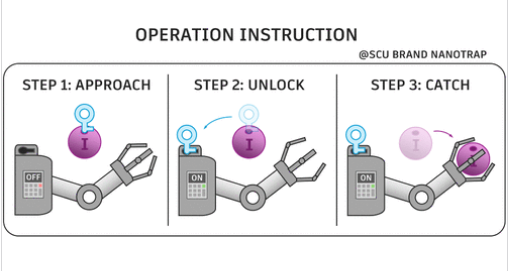
近日,苏州大学王殳凹团队报道了反应诱导后激活纳米阱策略用于放射性有机碘化物的防泄漏固定化。2025年12月10日出版的《美国化学会志》发表了这项成果。
固定放射性有机碘化物对于放射性污染治理至关重要。然而,传统吸附剂常面临碘离子泄漏问题,且其在原子层面的固定机制尚不明确。
研究组提出了一种反应诱导后激活的纳米陷阱策略,用于实现痕量甲基碘的抗泄漏固定。该策略利用稳定金属有机框架材料中的纳米陷阱,在化学吸附过程中通过甲基化原位激活,进而精确限域生成碘离子,首次实现了化学吸附态放射性有机碘化物的晶体学可视化。结构与计算分析表明,多重弱相互作用协同络合碘离子的强度可与共价键媲美,这使得该材料展现出优于现有顶级吸附剂的卓越抗泄漏性能。该研究为核素截留的抗泄漏材料设计提供了新策略,并填补了关于材料如何与放射性有机碘化物相互作用的认知空白。
附:英文原文
Title: Reaction-Induced Post-Activated Nanotrap Strategy for Leakage-Resistant Immobilization of Radioactive Organic Iodide
Author: Zhiwei Li, Dan Zhou, Linwei He, Yingtong Fan, Sen Mei, Zhonglin Ma, Songbai Tang, Zhiyong Peng, Long Chen, Lin Zhu, Jinghang Wang, Baoyu Li, Lixi Chen, Chao Zhao, Hailong Zhang, Yanlong Wang, Shuao Wang
Issue&Volume: December 10, 2025
Abstract: Immobilizing radioactive organic iodides (ROIs) is essential for radioactive-pollution remediation. However, conventional ROI sorbents often suffer from I– leakage, and the atomic-level mechanisms underlying ROI immobilization remain unclear. Herein, a reaction-induced postactivated nanotrap strategy is proposed for the leakage-resistant immobilization of trace-level methyl iodide. The nanotrap in a stable metal–organic framework (SCU-365) undergoes in situ activation by methylation during chemisorption and then precisely confines the generated I–, which enables the crystallographic visualization of chemisorbed ROI for the first time. Structural and computational analyses reveal that the synergy of multiple weak interactions for I– complexation rivals the strength of a covalent bond, endowing SCU-365 with exceptional leakage resistance superior to that of state-of-the-art ROI sorbents. This work proposes a novel strategy for antileakage material design for nuclide sequestration and fills the gap of understanding how materials interact with ROI.
DOI: 10.1021/jacs.5c15907
Source: https://pubs.acs.org/doi/abs/10.1021/jacs.5c15907
JACS:《美国化学会志》,创刊于1879年。隶属于美国化学会,最新IF:16.383
官方网址:https://pubs.acs.org/journal/jacsat
投稿链接:https://acsparagonplus.acs.org/psweb/loginForm?code=1000