
近日,
聚合物光催化剂中的载流子复合过程包含未解离激子衰减与电荷重组两方面,这是限制其光催化活性的主要瓶颈。在聚合物体系中实现高效的电荷生成与分离,是太阳能转化为氢能可能取得成功的基础策略,但这仍面临巨大挑战。
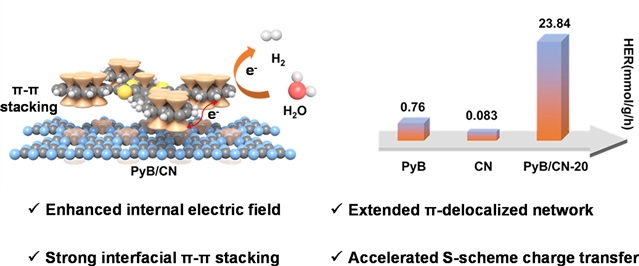
研究组提出一种创新的分子间π-π堆积策略,构建了用于光催化析氢的π离域全聚合物S型异质结。他们合成了两种共轭多孔聚合物——由苯并[1,2-b:4,5-b′]二噻吩(BDT)与芘单元组成的PyB,以及由BDT与苯组成的PhB,并将其与CN纳米片复合。PyB的高平面性和π扩展结构促进了其与CN之间形成强界面π-π堆积,构建出扩展的π离域网络,从而增强了内建电场,提升了电荷分离效率并拓宽了可见光吸收范围。最终,优化后的PyB/CN-20复合材料在可见光下实现了23.84毫摩尔/小时/克的卓越析氢速率,较原始CN提升约287倍。
这项工作揭示了聚合物平面性与π共轭体系在异质结效率中的关键作用,为理性设计π离域S型体系提供了新视角,并通过分子层面的结构调控建立了一种开发高效无金属光催化剂的通用策略。
附:英文原文
Title: Engineering π-delocalized network in fused-thiophene based polymers/g-C3N4 S-scheme heterojunctions for photocatalytic H2 evolution
Author: anonymous
Issue&Volume: 2025-12-08
Abstract: Carrier recombination in polymer photocatalysts involves both undissociated exciton decay and charge recombination, which are the main obstacles limiting their photocatalytic activity. Achieving efficient charge generation and separation in a polymer system is a fundamental strategy for the potential success of solar energy conversion to hydrogen, but it remains a huge challenge. In this study, we propose an innovative intermolecular π–π stacking strategy to construct a π-delocalized all-polymer S-scheme heterojunction for photocatalytic hydrogen evolution. Two conjugated porous polymers (CPPs)—PyB, composed of benzo[1,2-b:4,5-b′]dithiophene (BDT) and pyrene units, and PhB, composed of BDT and benzene—were synthesized and integrated with CN nanosheets. The highly planar and π-extended structure of PyB facilitated strong interfacial π–π stacking with CN, forming an extended π-delocalized network that enhanced the internal electric field (IEF), improved charge separation, and boosted visible-light absorption. As a result, the optimized PyB/CN-20 composite achieved a remarkable hydrogen evolution rate (HER) of 23.84 mmolh1g1 under visible light, approximately 287 times higher than that of pristine CN. This work underscores the critical role of polymer planarity and π-conjugation in heterojunction efficiency, and provides new insights into the rational design of π-delocalized S-scheme systems and establishes a general strategy for developing highly efficient, metal-free photocatalysts by leveraging molecular-level structural control.
DOI: 10.1016/j.cjsc.2025.100833
Source: https://cjsc.ac.cn/cms/issues/939
Chinese Journal of Structural Chemistry:《结构化学》,创刊于1982年。隶属于中国结构化学杂志,最新IF:2.2
官方网址:http://cjsc.ac.cn/
投稿链接:https://www2.cloud.editorialmanager.com/cjschem/default2.aspx