
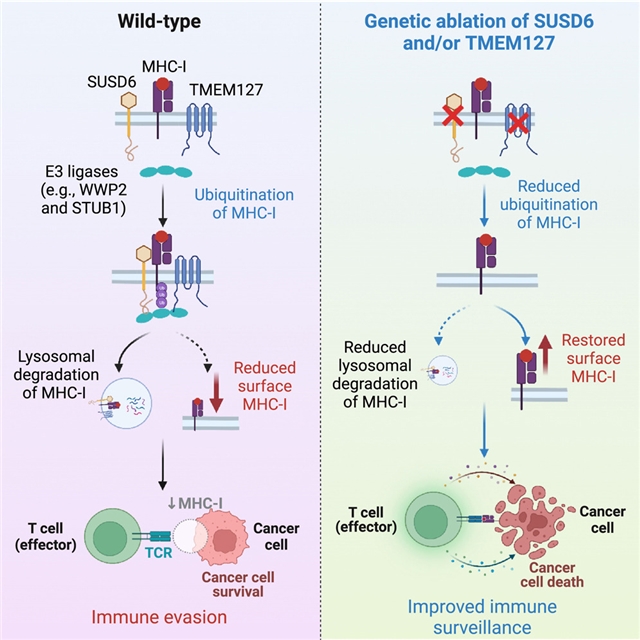
美国纽约大学王俊等研究人员合作发现癌症免疫逃避的一条膜相关MHC-I抑制轴。这一研究成果于2023年8月8日在线发表在国际学术期刊《细胞》上。
研究人员表示,免疫检查点阻断疗法给癌症治疗带来了革命性的变化,但有些癌症,如急性髓性白血病(AML),却没有反应或产生抗药性。一种潜在的抗药性模式是涉及主要组织相容性复合体I类(MHC-I)抗原递呈(AP)异常的T细胞免疫逃避。
为了绘制这种抗药性机制的图谱,研究人员利用特异性多肽-MHC-I引导的CRISPR-Cas9在AML中进行筛选,并确定了关键的MHC-I调节因子。排名前列的负调控因子是SUSD6(surface protein sushi domain containing 6)、跨膜蛋白127(TMEM127)和E3泛素连接酶WWP2。SUSD6在急性髓细胞性白血病和多种实体瘤中大量表达,消减SUSD6可增强MHC-I AP,并以CD8+T细胞依赖的方式减少肿瘤生长。从机理上讲,SUSD6与TMEM127和MHC-I形成三分子复合物,后者招募WWP2对MHC-I进行泛素化和溶酶体降解。SUSD6/TMEM127/WWP2基因特征与癌症存活率呈负相关,这些研究结果将膜相关MHC-I抑制轴定义为白血病和实体瘤的潜在治疗靶点。
附:英文原文
Title: A membrane-associated MHC-I inhibitory axis for cancer immune evasion
Author: Xufeng Chen, Qiao Lu, Hua Zhou, Jia Liu, Bettina Nadorp, Audrey Lasry, Zhengxi Sun, Baoling Lai, Gergely Rona, Jiangyan Zhang, Michael Cammer, Kun Wang, Wafa Al-Santli, Zoe Ciantra, Qianjin Guo, Jia You, Debrup Sengupta, Ahmad Boukhris, Hongbing Zhang, Cheng Liu, Peter Cresswell, Patricia L.M. Dahia, Michele Pagano, Iannis Aifantis, Jun Wang
Issue&Volume: 2023-08-08
Abstract: Immune-checkpoint blockade has revolutionized cancer treatment, but some cancers,such as acute myeloid leukemia (AML), do not respond or develop resistance. A potentialmode of resistance is immune evasion of T cell immunity involving aberrant major histocompatibilitycomplex class I (MHC-I) antigen presentation (AP). To map such mechanisms of resistance,we identified key MHC-I regulators using specific peptide-MHC-I-guided CRISPR-Cas9screens in AML. The top-ranked negative regulators were surface protein sushi domaincontaining 6 (SUSD6), transmembrane protein 127 (TMEM127), and the E3 ubiquitin ligaseWWP2. SUSD6 is abundantly expressed in AML and multiple solid cancers, and its ablationenhanced MHC-I AP and reduced tumor growth in a CD8+ T cell-dependent manner. Mechanistically, SUSD6 forms a trimolecular complex withTMEM127 and MHC-I, which recruits WWP2 for MHC-I ubiquitination and lysosomal degradation.Together with the SUSD6/TMEM127/WWP2 gene signature, which negatively correlates withcancer survival, our findings define a membrane-associated MHC-I inhibitory axis asa potential therapeutic target for both leukemia and solid cancers.
DOI: 10.1016/j.cell.2023.07.016
Source: https://www.cell.com/cell/fulltext/S0092-8674(23)00783-3