
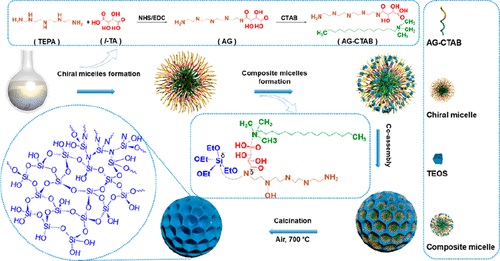
手性介孔二氧化硅(mSiO2)纳米材料在过去二十年中受到了极大的关注。它们大多表现出拓扑特征螺旋;然而,很少有人关注mSiO2框架的分子尺度手性。
该文中,眼肉均匀报道了一种手性酰胺凝胶定向合成策略,用于在硅酸盐骨架中制备具有类似分子尺度手性的手性mSiO2纳米球。手性酰胺凝胶通过静电相互作用对胶束进行功能化,实现了分子构型手性二氧化硅溶胶的生长。随后的模块化自组装导致形成具有二氧化硅框架的分子手性的树枝状大介孔二氧化硅纳米球。因此,所得手性mSiO2纳米球显示出丰富的大介孔(~10.1 nm)、高孔体积(~1.8 cm3·g–1)、高表面积(~525 m2·g–2)和明显的CD活性。
手性从手性酰胺凝胶成功转移到复合胶束,并进一步转移到基于模块化自组装的不对称二氧化硅聚合物框架,导致最终产物中存在分子手性。手性mSiO2框架在高温煅烧(甚至高达1000°C)后显示出良好的手性稳定性。手性mSiO2可以显著降低β-淀粉样蛋白(aβ42)的聚集形成,最高可达79%,从而显著减轻aβ42诱导的体外对人神经母细胞瘤系SH-ST5Y细胞的细胞毒性。
该发现为在光学和生物医学应用中构建纳米材料的分子手性构型开辟了一条新途径。
附:英文原文
Title: Chiral Skeletons of Mesoporous Silica Nanospheres to Mitigate Alzheimer’s β-Amyloid Aggregation
Author: Li Xu, Min Guo, Chin-Te Hung, Xiao-Lei Shi, Yiwen Yuan, Xingmiao Zhang, Ren-Hua Jin, Wei Li, Qiang Dong, Dongyuan Zhao
Issue&Volume: April 1, 2023
Abstract: Chiral mesoporous silica (mSiO2) nanomaterials have gained significant attention during the past two decades. Most of them show a topologically characteristic helix; however, little attention has been paid to the molecular-scale chirality of mSiO2 frameworks. Herein, we report a chiral amide-gel-directed synthesis strategy for the fabrication of chiral mSiO2 nanospheres with molecular-scale-like chirality in the silicate skeletons. The functionalization of micelles with the chiral amide gels via electrostatic interactions realizes the growth of molecular configuration chiral silica sols. Subsequent modular self-assembly results in the formation of dendritic large mesoporous silica nanospheres with molecular chirality of the silica frameworks. As a result, the resultant chiral mSiO2 nanospheres show abundant large mesopores (~10.1 nm), high pore volumes (~1.8 cm3·g–1), high surface areas (~525 m2·g–1), and evident CD activity. The successful transfer of the chirality from the chiral amide gels to composited micelles and further to asymmetric silica polymeric frameworks based on modular self-assembly leads to the presence of molecular chirality in the final products. The chiral mSiO2 frameworks display a good chiral stability after a high-temperature calcination (even up to 1000 °C). The chiral mSiO2 can impart a notable decline in β-amyloid protein (Aβ42) aggregation formation up to 79%, leading to significant mitigation of Aβ42-induced cytotoxicity on the human neuroblastoma line SH-ST5Y cells in vitro. This finding opens a new avenue to construct the molecular chirality configuration in nanomaterials for optical and biomedical applications.
DOI: 10.1021/jacs.2c12214
Source: https://pubs.acs.org/doi/10.1021/jacs.2c12214
JACS:《美国化学会志》,创刊于1879年。隶属于美国化学会,最新IF:16.383
官方网址:https://pubs.acs.org/journal/jacsat
投稿链接:https://acsparagonplus.acs.org/psweb/loginForm?code=1000